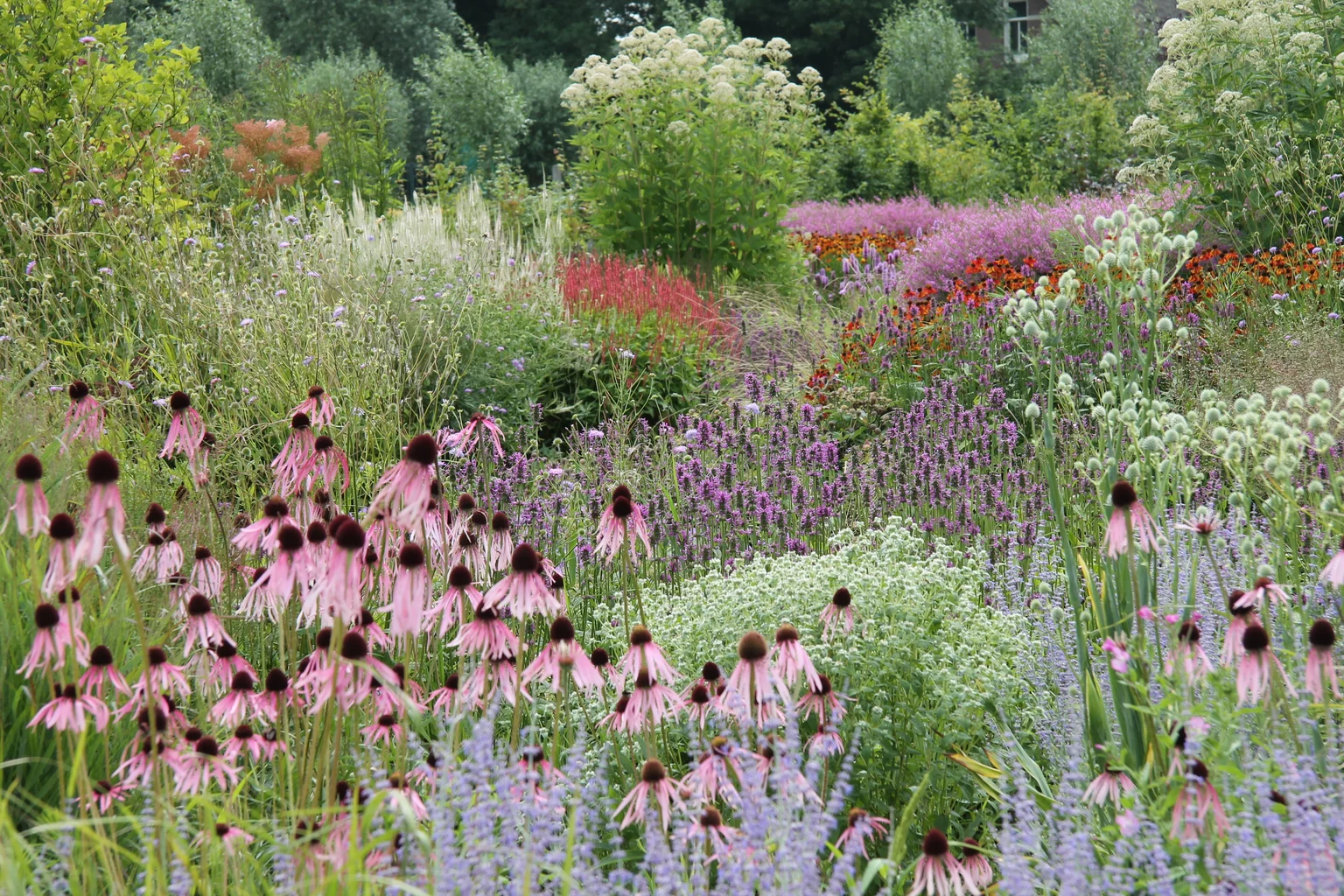
A flower-filled border is also an agreement about who will look after it. Vlinderhof provides a documented example of a residents’ initiative that became an existing public garden. The summer photographs show the planting; the garden’s own history explains the people who keep it going.
An existing garden · independently researched
- Place
- Máximapark, Utrecht, the Netherlands
- Design and care
- Piet Oudolf (design), initiated by residents including Marc Kikkert; maintained by Vlinderhof volunteers
- History
- Opened in 2014; the garden’s own site records its tenth anniversary in May 2024.
Garden Ideas Now did not design, build or survey this garden. The source accounts establish its history; the observations and smaller adaptations below are our editorial reading.
Another view of the built garden
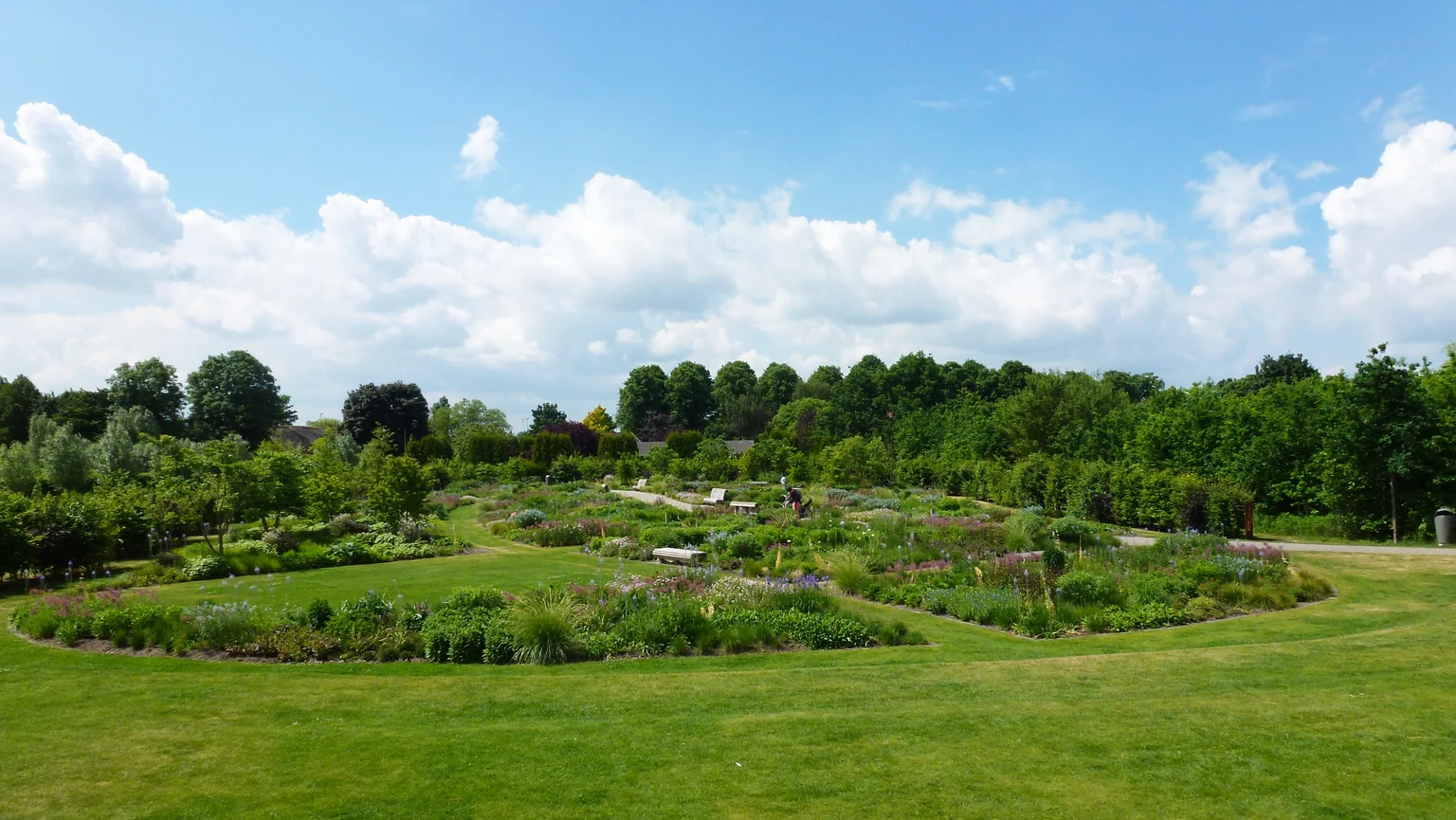
Piet Oudolf’s Vlinderhof planting in Máximapark.
Photo: Agaath · CC BY-SA 4.0 · Source & caption
Photo title & reuse details
Vlinderhof van Piet Oudolf (Máximapark).jpg. Resized and converted to WebP; original composition retained.
These are licensed photographs of the named existing garden. Different views and dates do not constitute a measured survey or a controlled before-and-after sequence. Full photograph and Pin credits.
An existing garden with named authors and carers
The Vlinderhof’s own account credits Piet Oudolf as designer and describes its origin as a residents’ initiative in Utrecht’s Máximapark. It also identifies volunteers as its gardeners and records a tenth-anniversary celebration in May 2024. The park’s published interview with initiator Marc Kikkert dates opening to spring 2014.
The planting is part of a public garden, rather than a private garden commissioned or built by Garden Ideas Now. Its official plant list and interactive map are useful primary references for what the garden reports growing.
Read the summer planting without inventing a plan
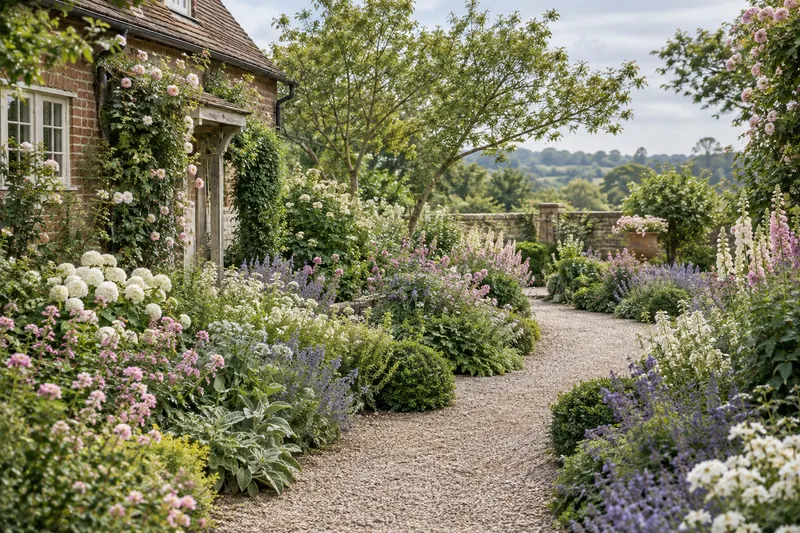
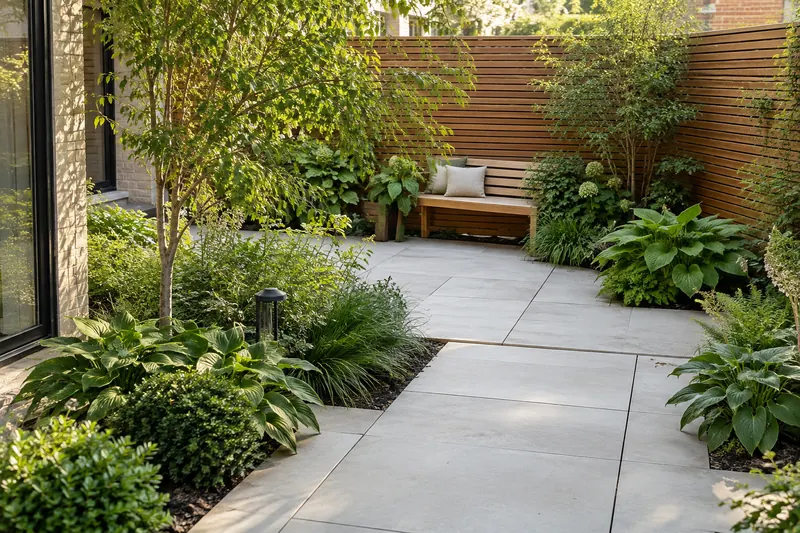
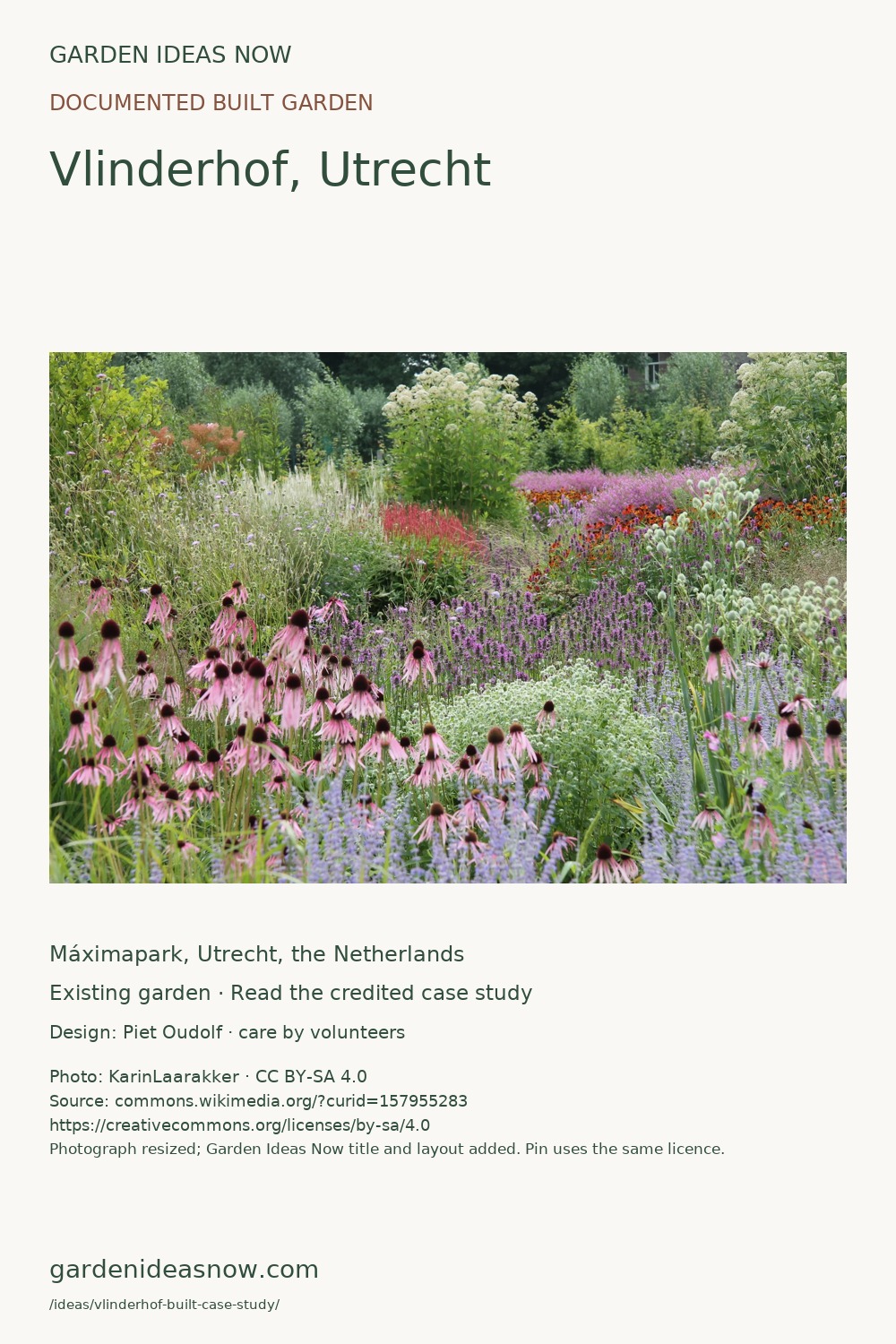
Our visual reading: the first view layers upright flowers and softer planting across the bed. The second view shows another photographed part of the garden. Repetition helps a rich mixture remain readable from a distance.
These are independent views, not a measured plan or a controlled comparison. A photograph cannot tell you the mature spacing, exact cultivar or current quantity of every plant. Consult the official map for this garden, then draw a separate plan for your own space.
The care agreement comes before expansion
The park’s interview describes both weeding and rejuvenating plants, with a longer-term plan for the garden’s development. The volunteer organisation is part of the project’s success; a full summer image does not establish a low-maintenance promise.
For a shared domestic or community border, name who will check establishment water, who will weed, and who can divide plants when needed. Keep a short record that another gardener can understand during holidays or changes of ownership.
Translate the idea to a smaller border
Our suggested first phase: repeat a small number of locally suitable plants in one reachable bed, then assess two growing seasons before increasing the area. Use our prairie starter or moist sunny border only when their different moisture assumptions fit.
Those measured examples are our illustrative designs. They are not copies of Oudolf’s plan and are not presented as the plant inventory in these photographs. Check mature spread and growing conditions for each chosen species.
Record the resting season and the unknowns
The photographs here show particular views at particular times; they do not document the whole seasonal cycle. Record what remains in winter at your own trial, where stems collapse and how clear the route stays. Decide what to retain or cut with those observations.
We have not surveyed this garden, audited its biodiversity or verified a transferable construction cost. Keep the design lesson, the photographer’s credit and the care commitment together when saving this example to a brief.
Make this idea yours.
Choose one element from this guide to trial first. Record your light, soil, available space and care time, then use those observations to decide the next step.
Your starting project notes
Garden project direction: Vlinderhof: seasonal planting sustained by a community. A real public garden in Utrecht, designed by Piet Oudolf and maintained by volunteers. Look at its repeated planting and the care organisation behind the summer view. Site checks: Built public garden in Máximapark, Utrecht · seasonal perennial and grass planting · volunteer care · local soil and water suitability still need checking. Care: high. I want to keep the element that fits my space and simplify the rest. Before buying or building, agree the local plant suitability, dimensions, access, water supply, permissions, cost and maintenance. Reference: https://gardenideasnow.com/ideas/vlinderhof-built-case-study/
Keep the assumptions visible
Sources & checks
This case study documents an existing garden. Its history and design authorship are attributed to the primary sources below; our visual reading and suggested adaptations are editorial observations. We have not surveyed the garden. Sources checked on 15 October 2026. Local conditions still determine suitability.
- Vlinderhof: garden authorship, volunteers and anniversary
- Vlinderhof: origins of the residents’ initiative
- Máximapark: Lucie Vermij’s interview with Marc Kikkert, 2021
- Vlinderhof: official plant list and map
These examples do not imply an on-site assessment or professional approval. Read our editorial approach.

.jpg)

.jpg)