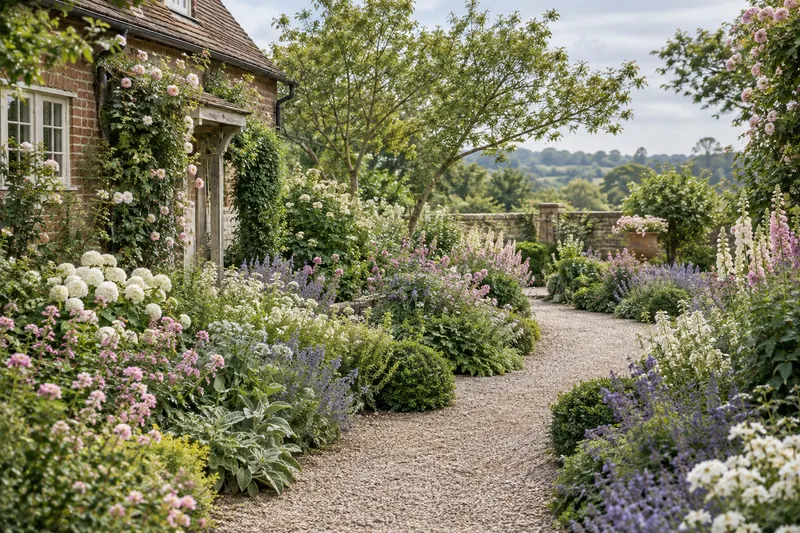
The pleasure of a cottage garden is its apparent generosity: flowers lean towards a path, useful plants share space with ornamentals, and the garden changes as the season moves on. The underlying design needs enough order to keep that abundance enjoyable.
Choose what “abundant” should mean
The RHS describes the English cottage tradition as a mixture of productive and flowering plants within a simple framework. Use that as a starting point, not a rule that every garden must contain the same roses and climbers. An English-inspired border in a hot, dry region needs a different planting palette from a cool, moist one.
Choose a flower-led garden if cutting and deadheading are part of the pleasure. Choose a mixed kitchen-and-flower garden if regular harvesting justifies frequent visits. Choose a foliage-led interpretation if you prefer fewer seasonal replacements. Reject the full mixed version when you cannot reach the plants without stepping into the bed.
Make a small working layout
In an illustrative 4 × 6 m garden, keep a 1.2 × 6 m central route: 7.2 m². The two remaining strips are each 1.4 × 6 m. Reserve the final 2 m of one strip for a 2.8 m² seat pocket. That leaves 14 m² for planting. The route width is a design example; test it with the people and equipment who will use it.
Keep the seat pocket visually connected to the path so it does not become an unreachable opening in mature plants. Let the soft edge occur on the garden side of a defined clear route. A flower leaning into the only access path is a maintenance task, not free extra space.
Draw these allocations in the planner, then compare the alternative of a side route in the long-garden example. The side route gives a larger continuous border but a less symmetrical arrival.
Repeat roles, then vary the flowers
Choose one recurring upright form, one broader mound and one lower connecting layer. In a suitable sunny, draining bed, Salvia nemorosa can supply the spikes and Echinacea purpurea a taller summer layer. These two roles do not fill every season; decide what the bed will look like before and after their main display.
Use a small annual patch only where there is access for sowing, replacements and watering. Keep vigorous climbers on an assessed support with their own root space. In shade, switch the whole planting logic to fern and broad-leaf contrasts; forcing sun-loving flowers into a shaded border rarely recreates the intended effect.
Choose a colour rhythm you can maintain
For the 14 m² example, mark three repeated groups along the length rather than buying fourteen unrelated specimens. A quiet combination might repeat violet and pale pink against green; a stronger one might repeat warm flowers with dark foliage. The drawing should still make sense without flowers, because colour is intermittent.
A white-flowered cultivar is not automatically the same size, vigour or flowering period as the species. Check the exact plant before substituting it. If a plant cannot be sourced, replace its role and dimensions first, then its colour. The plant finder makes the conditions and mature spread visible together.
Keep the looseness under control
During establishment, inspect water and weeds before concentrating on flowers. Later, the recurring work is selective: tie or support plants that lean into routes, remove unwanted seedlings while small, cut spent stems where repeat flowering is wanted, and leave other seed heads when they serve the winter composition.
Record which groups repeatedly need staking or rescue watering. A group that demands more work than you enjoy is a candidate for replacement with a sturdier, better-sited form. Retain the repeated pattern while reducing the task. Add the seasonal replacement and support costs to the budget; a cottage look is not automatically a low-cost or low-effort garden.
Keep the assumptions visible
Sources & checks
The layout and calculations are original illustrative examples. Horticultural and access guidance is informed by the sources below, checked on 3 October 2026. Local conditions still determine suitability.
- RHS: garden design styles (definitions and historical context)
- RHS: planning a border for its conditions
Prepared with AI assistance. No on-site assessment or professional approval is implied. Read our editorial approach.