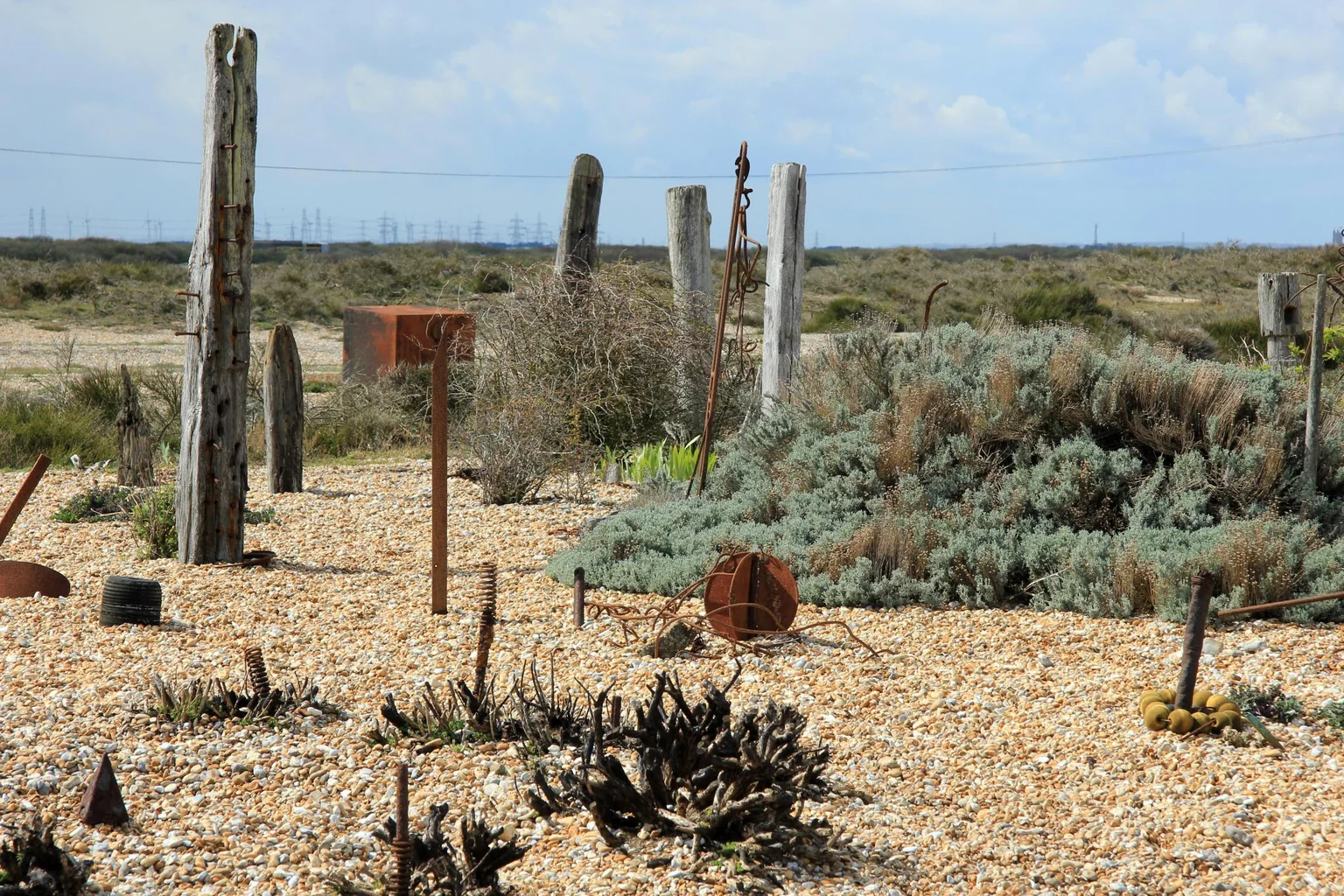
The dark cottage and its garden belong to the same exposed setting. Rather than presenting a tidy planting recipe, this case study looks at a real, highly personal place. The garden’s authorship and ongoing care are documented by its custodians; the photographs have their own named authors and reuse licences.
An existing garden · independently researched
- Place
- Dungeness, Kent, England
- Design and care
- Derek Jarman; later cared for by Keith Collins and subsequent custodians and gardeners
- History
- Jarman moved to Prospect Cottage in 1986. Creative Folkestone now cares for the cottage, garden and contents.
Garden Ideas Now did not design, build or survey this garden. The source accounts establish its history; the observations and smaller adaptations below are our editorial reading.
Another view of the built garden
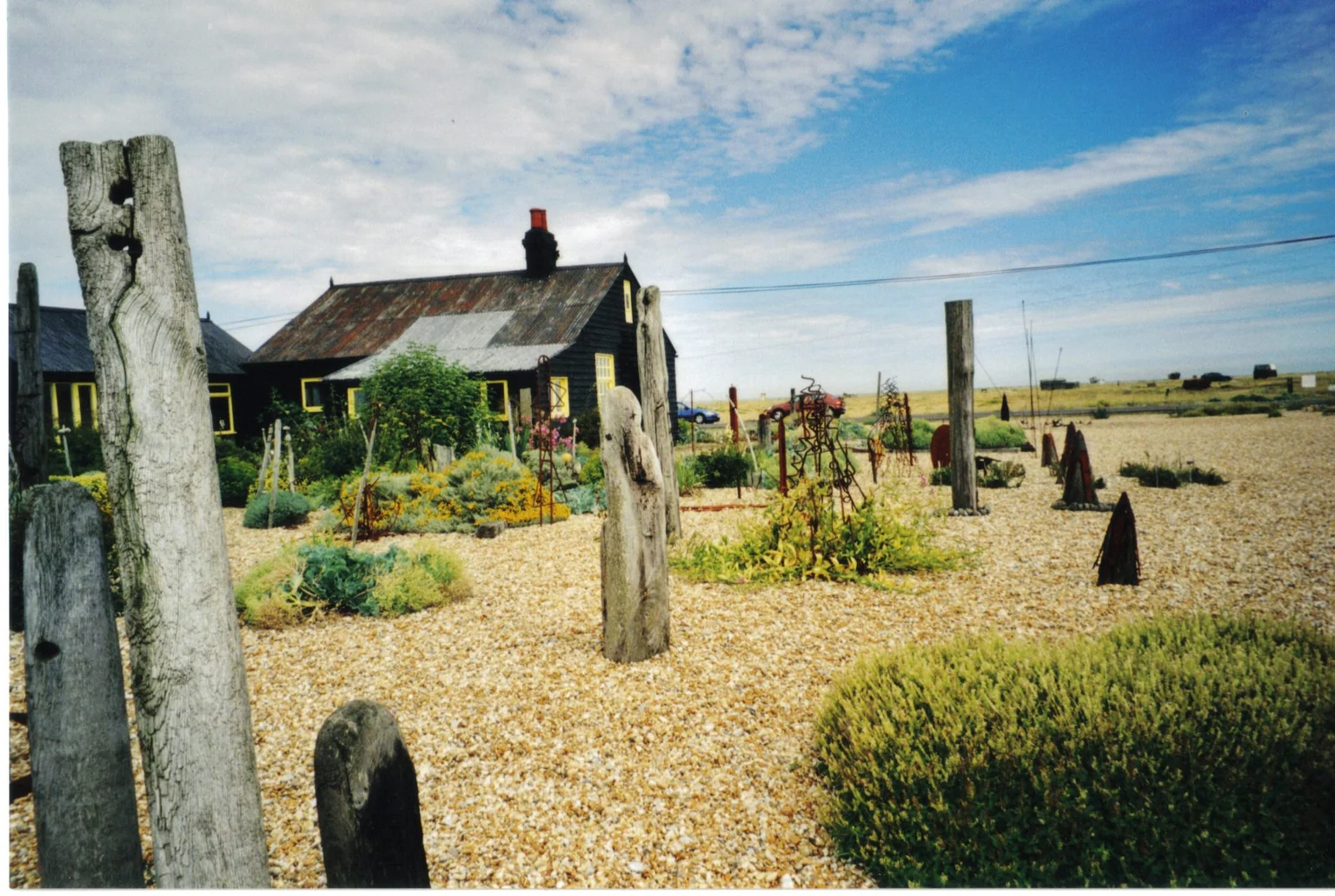
Derek Jarman’s garden at Dungeness.
Photo: Tim Brighton · CC BY-SA 2.0 · Source & caption
Photo title & reuse details
Dungeness garden.jpg. Resized and converted to WebP; original composition retained.
These are licensed photographs of the named existing garden. Different views and dates do not constitute a measured survey or a controlled before-and-after sequence. Full photograph and Pin credits.
The place, the maker and the continuing garden
Creative Folkestone identifies Prospect Cottage as the former home of filmmaker, artist, activist and gardener Derek Jarman, who moved to Dungeness in 1986. Its account connects his gardening with the shingle landscape and driftwood sculptures, and credits Keith Collins in the garden’s later story.
The Garden Museum’s report of a gardening placement describes a living place that is still tended. These photographs record views of that garden, rather than our own completed project.
Read the open ground between plants
Our visual reading: the shingle is visible between separate plants and objects. The cottage gives those scattered forms a strong background. The second view offers another look at the relationship between planting and open ground; it is not a matching seasonal or before-and-after photograph.
At home, try arranging a few lawful, stable objects on an existing surface before changing the entire garden. Keep the movement route legible and take a photograph from your main window. Empty space can be a deliberate part of the composition.
Exposure is a condition, not a style accessory
A coastal-looking surface does not create a suitable coastal root zone. Record wind, salt exposure, rainfall, drainage and the plants already growing at your own site. A gravel topping over wet or compacted soil is not an equivalent planting environment.
Our coastal-garden guide explains the site checks separately. The sea-thrift profile is one sourced candidate to investigate where suitable, not a plant identification or confirmed inventory for these photographs.
A smaller, responsible trial
Our suggested first phase: keep the existing route, trial one locally suitable plant group and add one object that belongs to your own story. Use purchased or already-owned materials with known provenance; do not remove shingle, timber or plants from protected coastal habitat.
Check stability, edges, household safety and maintenance access. Record establishment watering and losses honestly. This garden’s appearance does not demonstrate that a new planting elsewhere can survive without water.
Keep the authorship and limits in your brief
Use a credited image as a reference for spacing, silhouette or atmosphere. The garden’s history and artistic context belong to Jarman and its later custodians, not to this site. A public view does not grant access to private ground; check current custodian information before a visit.
We have no verified construction budget, surveyed bed dimensions or measured maintenance hours for this case. Write your own conditions and proposed trial beside the reference rather than turning the photograph into a shopping list.
Make this idea yours.
Choose one element from this guide to trial first. Record your light, soil, available space and care time, then use those observations to decide the next step.
Your starting project notes
Garden project direction: Prospect Cottage: a personal garden in an exposed landscape. Derek Jarman’s existing shingle garden at Dungeness connects plants, open ground and found forms. Borrow the attention to place while keeping your own materials, habitat and access checks. Site checks: Built coastal garden at Dungeness, Kent · exposed shingle setting · a personal, evolving garden, not a universal no-water planting recipe. Care: high. I want to keep the element that fits my space and simplify the rest. Before buying or building, agree the local plant suitability, dimensions, access, water supply, permissions, cost and maintenance. Reference: https://gardenideasnow.com/ideas/prospect-cottage-built-case-study/
Keep the assumptions visible
Sources & checks
This case study documents an existing garden. Its history and design authorship are attributed to the primary sources below; our visual reading and suggested adaptations are editorial observations. We have not surveyed the garden. Sources checked on 15 October 2026. Local conditions still determine suitability.
- Creative Folkestone: Prospect Cottage’s maker, history and custodianship
- Garden Museum: tending Prospect Cottage as a living garden
These examples do not imply an on-site assessment or professional approval. Read our editorial approach.
.jpg)