Foliage can carry a small garden through long intervals between flowers. This plan uses differences in height, outline and texture rather than depending on many colours appearing at once.
Choose foliage as the main event
Use this scheme where a shaded view matters more than a long flowering season. Check that the position has suitable moisture and shelter. The cast iron plant is the principal cold-climate constraint, so do not judge the whole palette by the hardiest fern.
For a colder suitable site, replace the central cast iron plant with one additional Christmas fern at the same 1 m allocation, after checking local suitability. That changes the original list from one cast iron plant plus two ferns to three ferns. Make the change in the planner before exporting the shopping list.
Read the measured planting plan
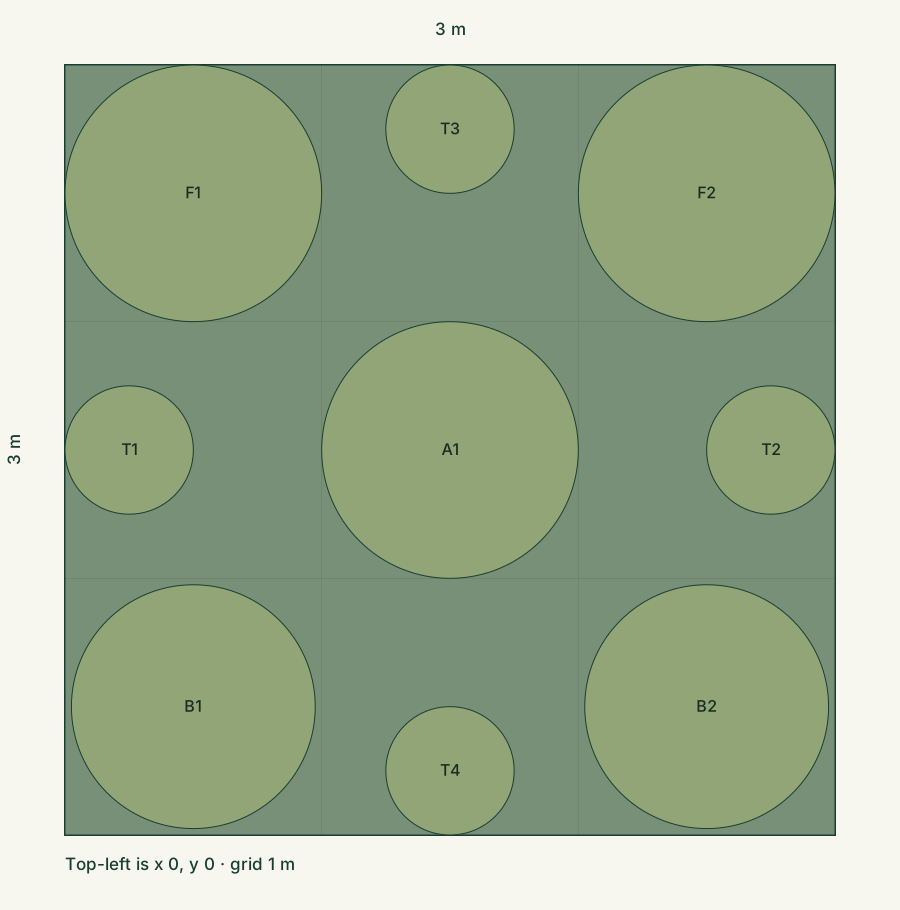
The outline is 3 × 3 m: 9 m². Planting beds occupy 9 m². The top is the visual rear, not a compass bearing. Paths outside the outline are additional space. Test reach and maintenance access before copying it; widen access or divide deep beds where needed.
Circles reserve adult spread, not the size of a new nursery pot. Gaps are deliberate. Soil and neighbouring growth can change the eventual size, so check the named plants and keep the ability to edit the scheme. The diagram is an original concept, not an installed garden.
Open this layout in the planner, choose “Use this example,” then edit positions and dimensions. Its current plant inventory follows additions and deletions. Export the editable plan as well as the drawing.
Use contrast and a clear centre
The central upright leaves are framed by two fern clumps at the rear, two broad-leaved bergenias towards the front and four lower foamflowers between them. The diagram is compact enough to inspect from all sides if the surrounding access exists.
Spring flowers are a bonus to the leaf composition. Winter appearance depends on climate, damage and the plants' actual performance; evergreen does not mean every leaf remains immaculate. View the proposed arrangement without flower colour before deciding it is complete.
Shopping list and exact positions
| Plant | Count | Diameter each |
|---|---|---|
| Aspidistra elatior | 1 | 1 m |
| Polystichum acrostichoides | 2 | 1 m |
| Bergenia crassifolia | 2 | 0.95 m |
| Tiarella cordifolia | 4 | 0.5 m |
Total: 9 individual planting positions. Open each profile for source-backed size, light, moisture, climate and safety checks. A botanical match alone does not establish local native status or suitability.
Show centre coordinates for setting out
Measure x from the left and y from the top. All coordinates are metres. Plant labels match the diagram.
| Label | Centre x | Centre y |
|---|---|---|
| A1 | 1.5 | 1.5 |
| F1 | 0.5 | 0.5 |
| F2 | 2.5 | 0.5 |
| B1 | 0.5 | 2.5 |
| B2 | 2.5 | 2.5 |
| T1 | 0.25 | 1.5 |
| T2 | 2.75 | 1.5 |
| T3 | 1.5 | 0.25 |
| T4 | 1.5 | 2.75 |
Set out empty pots or temporary markers first. Check views, access and the mature circles before planting. For a compatible material applied at an illustrative 5 cm depth, the full bed area would be 450 litres before subtracting obstructions and crown clearances. This is geometry, not a prescribed mulch type or depth for every plant. Calculate your actual material and depth.
Keep light and water compatible
Use sheltered shade rather than a hot exposed sun pocket for the central cast iron plant. Inspect the low foamflower positions for drying. If the site has dry shade, switch to the separate trial plan rather than trying to maintain this moister composition by habit.
During establishment, keep individual records of water and growth. A large leaf can shade a smaller neighbour before its root system is fully established. Adjust placement or reduce competition when evidence shows a mismatch.
Edit by shape as the planting matures
Remove damaged foliage and manage spreading lower growth where it erases the intended contrast. Retain enough separation to see the larger forms. If a broad-leaved clump repeatedly overwhelms the central view, divide or relocate it according to appropriate plant guidance.
For a simpler composition with fewer climate decisions, use the fern-and-foamflower border. Compare both in the notebook, including mature sizes and the work needed to retain their shapes.
Keep the assumptions visible
Sources & checks
The layout and calculations are original illustrative examples. Horticultural and access guidance is informed by the sources below, checked on 3 October 2026. Local conditions still determine suitability.
- RHS: planning a border from conditions and mature plant size
- NC State: Aspidistra elatior — dimensions and conditions
- NC State: Polystichum acrostichoides — dimensions and conditions
- NC State: Bergenia crassifolia — dimensions and conditions
- NC State: Tiarella cordifolia — dimensions and conditions
Prepared with AI assistance. No on-site assessment or professional approval is implied. Read our editorial approach.