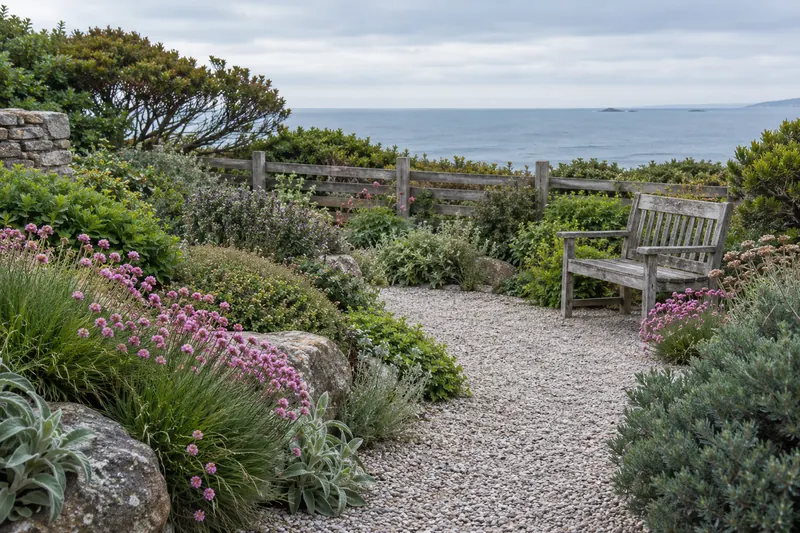
“Coastal” describes a location, not one climate. A cool salt-sprayed headland, a sheltered seaside courtyard and a hot sandy coast need different plants and different maintenance plans.
Map three different stresses
Mark the direction of damaging winds, where salt reaches foliage and which parts of the ground dry quickly or stay wet. A plant coping with sandy soil may still be vulnerable to direct salt spray. A sheltered corner may support choices that fail a few metres away.
Choose a low exposed planting where a broad sea view is the priority. Choose a sheltered inner garden if comfort and a wider palette matter more. Choose a small protected container group only where stability, watering and winter care are feasible. Tall lightweight screens are a poor shortcut in exposed wind.
Allocate shelter without promising a performance figure
On a 6 × 8 m plot, reserving a 1.5 × 8 m strip along the windward edge uses 12 m², leaving 36 m² for other purposes. This is a space reservation, not a hedge specification: the actual species may need more mature width, and shelter depends on its height, porosity and surroundings.
The RHS distinguishes wind-filtering barriers from solid obstructions that can create turbulence. Ask a local designer or competent installer to assess the appropriate structure, permissions and exposure. A planted windbreak also needs time to establish; draw the temporary condition as well as the mature one.
Start with a low, source-backed trial
Armeria maritima is an option for suitable cool, sunny, sharply draining coastal conditions. Check the subspecies and local provenance if native habitat is the aim. It is not a universal answer for humid heat or saturated ground.
In a 2 × 0.8 m trial strip, mark five positions along each of two rows, at x 0.2, 0.6, 1.0, 1.4 and 1.8 m, and y 0.2 and 0.6 m. That is ten plants at 0.4 m centres. The spacing gives room beyond the profile's typical maximum spread. Keep the trial separate from plants requiring consistently richer, wetter ground.
Choose surfaces and furniture for exposure
Check corrosion resistance, stability and manufacturer care requirements rather than assuming every outdoor product tolerates salt. Loose gravel can move into routes or drains; smooth hard surfaces can be slippery when wet. Compare the actual product under the intended use.
Locate the main seat where observation confirms comfort. Keep a route for storm checks and debris removal. Do not harvest stones, driftwood or plants from protected coastal habitats without lawful permission; purchased provenance matters as much as the visual effect.
Treat the first seasons as evidence
Inspect establishment moisture and wind damage after significant weather. Record which edge of the trial suffers and whether the cause appears to be salt, drying, instability or poor drainage. Obtain a diagnosis before treating every brown leaf as a need for more water.
If shelter cannot be provided without losing a valued view or creating unacceptable maintenance, lower the planting and change the seating position. Save both alternatives in the notebook and price their actual materials in the budget. An inland “coastal look” can borrow restrained colours and textures, but should use plants for its inland conditions.
Keep the assumptions visible
Sources & checks
The layout and calculations are original illustrative examples. Horticultural and access guidance is informed by the sources below, checked on 3 October 2026. Local conditions still determine suitability.
Prepared with AI assistance. No on-site assessment or professional approval is implied. Read our editorial approach.