Autumn interest can come from foliage and the shape of a mature shrub, rather than a last flush of flowers. This arrangement makes that commitment visible: one large plant gets the space it needs, with a separate narrow edge across an access route.
Choose a shrub-led view only where it fits
Use this scheme for an edge seen from the house or a seat with enough room for a substantial shrub. The 3.1 m hydrangea circle is deliberately based on the larger source dimension. A young plant will leave open ground. Do not fill its future space with permanent plants that you cannot later move.
Choose this design for foliage scale and seasonal change. Choose the astilbe layout for lower flower groups. Choose the winter viewing border for winter fragrance and low flowers in a compatible milder site. These choices solve different seasonal briefs.
Read the measured planting plan
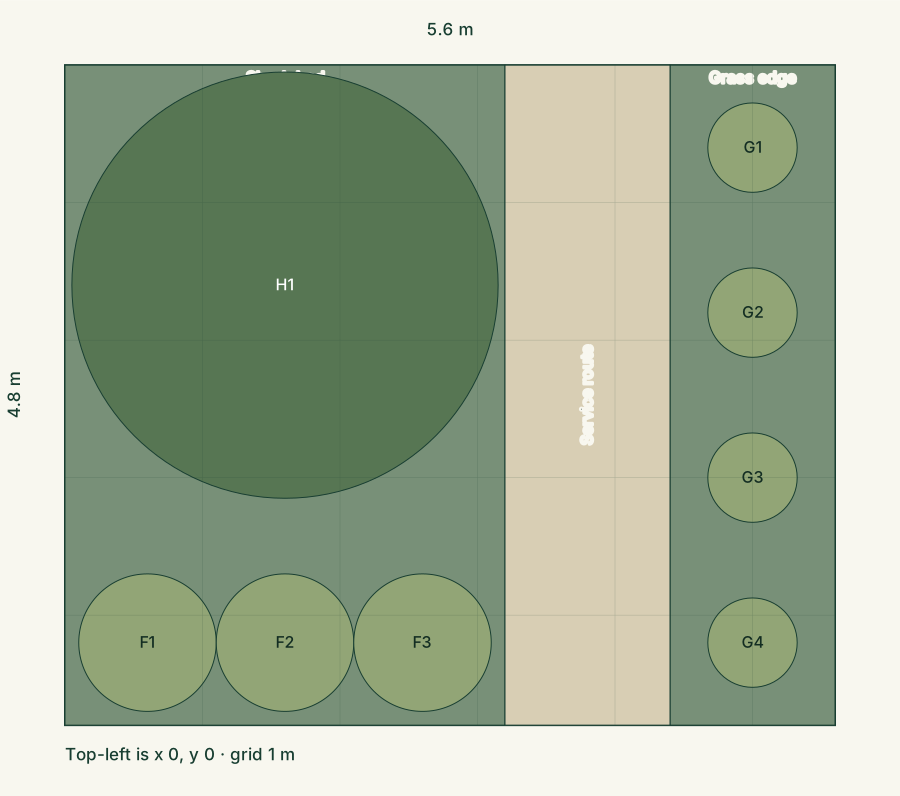
The outline is 5.6 × 4.8 m: 26.88 m². Planting beds occupy 21.12 m² and the internal route occupies 5.76 m². The top is the visual rear, not a compass bearing. Paths outside the outline are additional space. Test reach and maintenance access before copying it; widen access or divide deep beds where needed.
Circles reserve adult spread, not the size of a new nursery pot. Gaps are deliberate. Soil and neighbouring growth can change the eventual size, so check the named plants and keep the ability to edit the scheme. The diagram is an original concept, not an installed garden.
Open this layout in the planner, choose “Use this example,” then edit positions and dimensions. Its current plant inventory follows additions and deletions. Export the editable plan as well as the drawing.
Separate the canopy from the lower edge
The oakleaf hydrangea occupies the main bed; three ferns sit toward its nearer edge. Four Japanese forest grasses repeat across the route. Their low foliage provides contrast without placing an evergreen screen along the whole boundary. Verify each plant in its linked profile, especially the grass’s cool-summer limitation.
The route separates the large canopy from the smaller group. Draw the shrub’s eventual height as well as its width when checking windows and neighbouring space. The species plan is not suitable for a much narrower bed; a named dwarf selection is a new specification requiring a new mature-size check.
Shopping list and exact positions
| Plant | Count | Diameter each |
|---|---|---|
| Hydrangea quercifolia | 1 | 3.1 m |
| Polystichum acrostichoides | 3 | 1 m |
| Hakonechloa macra | 4 | 0.65 m |
Total: 8 individual planting positions. Open each profile for source-backed size, light, moisture, climate and safety checks. A botanical match alone does not establish local native status or suitability.
Show centre coordinates for setting out
Measure x from the left and y from the top. All coordinates are metres. Plant labels match the diagram.
| Label | Centre x | Centre y |
|---|---|---|
| H1 | 1.6 | 1.6 |
| F1 | 0.6 | 4.2 |
| F2 | 1.6 | 4.2 |
| F3 | 2.6 | 4.2 |
| G1 | 5 | 0.6 |
| G2 | 5 | 1.8 |
| G3 | 5 | 3 |
| G4 | 5 | 4.2 |
Set out empty pots or temporary markers first. Check views, access and the mature circles before planting. For a compatible material applied at an illustrative 5 cm depth, the full bed area would be 1056 litres before subtracting obstructions and crown clearances. This is geometry, not a prescribed mulch type or depth for every plant. Calculate your actual material and depth.
Expect colour, then an open winter view
Summer flower heads and broad leaves precede the autumn foliage display. The winter view includes branches and fern structure; the grass is deciduous. This is not an autumn-flowering collection or a year-round privacy hedge. Compare the view from indoors after leaf fall before relying on it for screening.
Keep a simple four-photo record, one for each seasonal phase, with a note of actual colour and duration. Shade intensity, weather and cultivar affect the result. If colour is weak but the plant is healthy, first revisit the light and cultivar assumptions rather than applying fertilizer as a colour treatment.
Maintain future space instead of repeated reduction
Keep the young shrub’s allocation clear enough for inspection. Use the profile’s flowering and pruning guidance rather than cutting it back on a universal winter schedule. An oversized plant repeatedly cut to fit indicates a design mismatch. Confirm the mature envelope when ordering.
Inspect the grass edge for dryness and heat stress and keep its expanding leaves out of the route. If the site has hot summers, use the alternative below before buying the grass. Path maintenance and access to the shrub remain part of the annual workload.
Change the weak component explicitly
For a locally suitable moist site where Japanese forest grass is a poor heat match, a verified carex oshimensis can occupy each 0.65 m grass allocation, subject to its own conditions. Its source-recorded spread is smaller. This substitution loses the same deciduous autumn effect and changes winter appearance; it is not a like-for-like colour swap.
If the shrub is too large, compare a named compact cultivar from a primary source and redraw the allocation, or choose a perennial-only plan. Do not reduce the species circle and leave the same shopping label. Keep the reason for the substitution, the new dimensions and the altered seasonal expectation together in the notebook.
Keep the assumptions visible
Sources & checks
The layout and calculations are original illustrative examples. Horticultural and access guidance is informed by the sources below, checked on 8 October 2026. Local conditions still determine suitability.
- RHS: planning a border from conditions and mature plant size
- NC State Extension Gardener Plant Toolbox: Hydrangea quercifolia — dimensions and conditions
- NC State Extension Gardener Plant Toolbox: Polystichum acrostichoides — dimensions and conditions
- NC State Extension Gardener Plant Toolbox: Hakonechloa macra — dimensions and conditions
These examples do not imply an on-site assessment or professional approval. Read our editorial approach.