Design this border for a place you already pass or see in winter. A distant flower patch is less useful when weather keeps you indoors. The arrangement puts the lower flowers at the front and the evergreen mass behind, without pretending that every plant flowers throughout winter.
Check climate, exposure and people first
The whole-zone plant filter is a shortlist only: sweet box’s detailed source starts at USDA 6b. Check exact local winter exposure and the other plants’ tolerances. A cold-hardiness number does not settle summer heat, wind or container-root survival. This is an in-ground, sheltered border.
Choose this scheme where a winter view and scent are welcome. If strong fragrance is unwelcome, use the foliage-led approach with its own climate checks. If the climate is too cold for the shrubs, the fern and bergenia scheme offers a different sourced direction, subject to moisture fit. It does not replace winter flowers with an identical display.
Read the measured planting plan
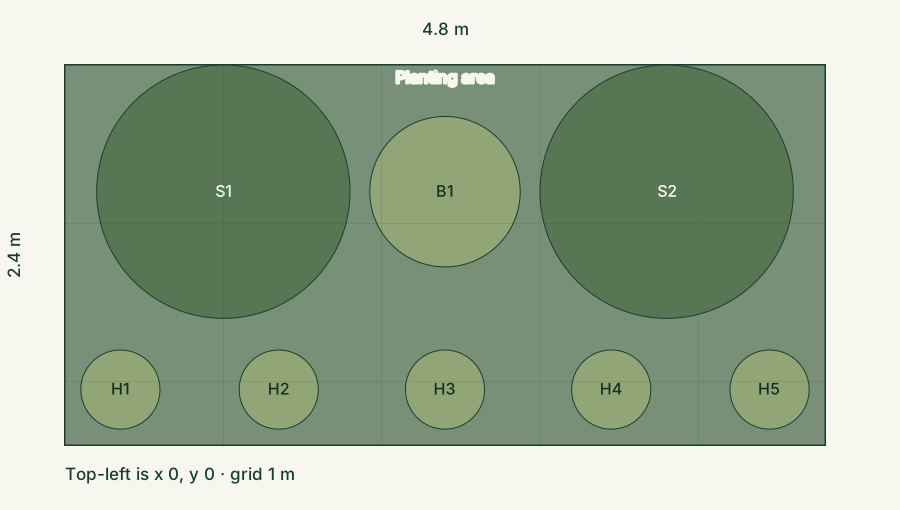
The outline is 4.8 × 2.4 m: 11.52 m². Planting beds occupy 11.52 m². The top is the visual rear, not a compass bearing. Paths outside the outline are additional space. Test reach and maintenance access before copying it; widen access or divide deep beds where needed.
Circles reserve adult spread, not the size of a new nursery pot. Gaps are deliberate. Soil and neighbouring growth can change the eventual size, so check the named plants and keep the ability to edit the scheme. The diagram is an original concept, not an installed garden.
Open this layout in the planner, choose “Use this example,” then edit positions and dimensions. Its current plant inventory follows additions and deletions. Export the editable plan as well as the drawing.
Frame the low flowers
Two sweet boxes each receive a 1.6 m diameter, one bergenia fills the central lower gap and five hellebores form a spaced front line. Put the viewing route outside the bed, with additional clearance beyond the drawing. The allocated circles must not extend into an essential path when the shrubs mature.
Hellebore identity matters: this plan specifies Helleborus orientalis, and nursery hybrids may differ. Check the exact label and dimensions. The plants have poison and contact-exposure warnings in the source; assess child, pet and maintenance access before adopting the scheme. A pleasing winter display is not a safety clearance.
Shopping list and exact positions
| Plant | Count | Diameter each |
|---|---|---|
| Sarcococca confusa | 2 | 1.6 m |
| Bergenia crassifolia | 1 | 0.95 m |
| Helleborus orientalis | 5 | 0.5 m |
Total: 8 individual planting positions. Open each profile for source-backed size, light, moisture, climate and safety checks. A botanical match alone does not establish local native status or suitability.
Show centre coordinates for setting out
Measure x from the left and y from the top. All coordinates are metres. Plant labels match the diagram.
| Label | Centre x | Centre y |
|---|---|---|
| S1 | 1 | 0.8 |
| S2 | 3.8 | 0.8 |
| B1 | 2.4 | 0.8 |
| H1 | 0.35 | 2.05 |
| H2 | 1.35 | 2.05 |
| H3 | 2.4 | 2.05 |
| H4 | 3.45 | 2.05 |
| H5 | 4.45 | 2.05 |
Set out empty pots or temporary markers first. Check views, access and the mature circles before planting. For a compatible material applied at an illustrative 5 cm depth, the full bed area would be 576 litres before subtracting obstructions and crown clearances. This is geometry, not a prescribed mulch type or depth for every plant. Calculate your actual material and depth.
Treat winter interest as several different things
The shrubs provide evergreen mass and small scented flowers; the front line supplies a late-winter-to-spring flower opportunity. Weather and local seasons set the dates. Bergenia contributes a different leaf shape. Winter foliage may be damaged, and hellebore leaf retention varies with climate.
After spring flowering, this is primarily a green composition. Keep the background, route and view useful during summer rather than adding unplanned annuals among established crowns. If summer colour is essential, reserve a separate appropriate area and budget for its care instead of claiming this scheme supplies it.
Establish and inspect from the actual viewing position
Mark the shrub envelopes with temporary markers and check the view from the window and the path. Set the low flower positions where you can see and maintain them without standing in the bed. Trial fragrance before making it an unavoidable part of a route.
During establishment inspect root-zone moisture, fallen leaves and clear access. Follow the individual profiles when removing damaged foliage; avoid a blanket cut-back that removes the structure you selected for winter. Keep appropriate protective handling and tool hygiene in the maintenance routine.
Use a different palette when the premise fails
If the shrub cannot tolerate the local winter, replacing it with a fern changes height, scent and screening. That may be a good decision, but record those lost functions. If household exposure makes hellebores unsuitable, do not substitute an unidentified “safe” flowering plant: establish exact identity and exposure advice, then redraw.
After one winter, record when the border was visible and enjoyed, any exposure damage, fragrance response and work required. Keep or simplify the scheme based on that record. The season-led care guide helps separate climate observations from calendar-month assumptions.
Keep the assumptions visible
Sources & checks
The layout and calculations are original illustrative examples. Horticultural and access guidance is informed by the sources below, checked on 8 October 2026. Local conditions still determine suitability.
- RHS: planning a border from conditions and mature plant size
- NC State Extension Gardener Plant Toolbox: Sarcococca confusa — dimensions and conditions
- NC State Extension Gardener Plant Toolbox: Bergenia crassifolia — dimensions and conditions
- NC State Extension Gardener Plant Toolbox: Helleborus orientalis — dimensions and conditions
These examples do not imply an on-site assessment or professional approval. Read our editorial approach.