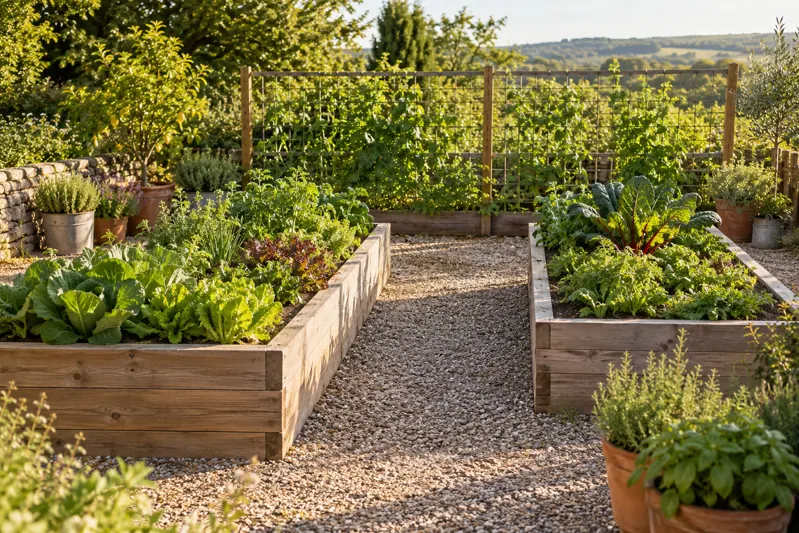
Start with one bed you can reach and inspect often. This example has three crop blocks with explicit positions and a first-season sequence. It is deliberately small enough to observe closely, and its quantities count plants that have space, not imagined harvests.
Choose the bed type after checking the site
Measure direct sun during the growing season and confirm a convenient water supply. Choose an in-ground bed when the existing soil, drainage and history are suitable. Choose a raised bed when a defined growing space or working height solves an actual problem and the structure, fill and access are appropriate. Choose containers when portability is more useful than a permanent bed.
A raised box does not by itself certify contaminated ground as safe. Investigate site history and obtain appropriate local testing and advice where contamination is possible. The EPA identifies soil, dust and tracked material as exposure routes, and recommends clean growing soil and other precautions. Resolve the site-specific plan before growing food in uncertain ground.
The 1.2 m bed width assumes access from both long sides. Test your reach; a narrower bed may work better. The diagram excludes paths, structural wall thickness and any wheelchair or tool clearances. Elevated balconies require the separate building checks.
Read the three crop blocks
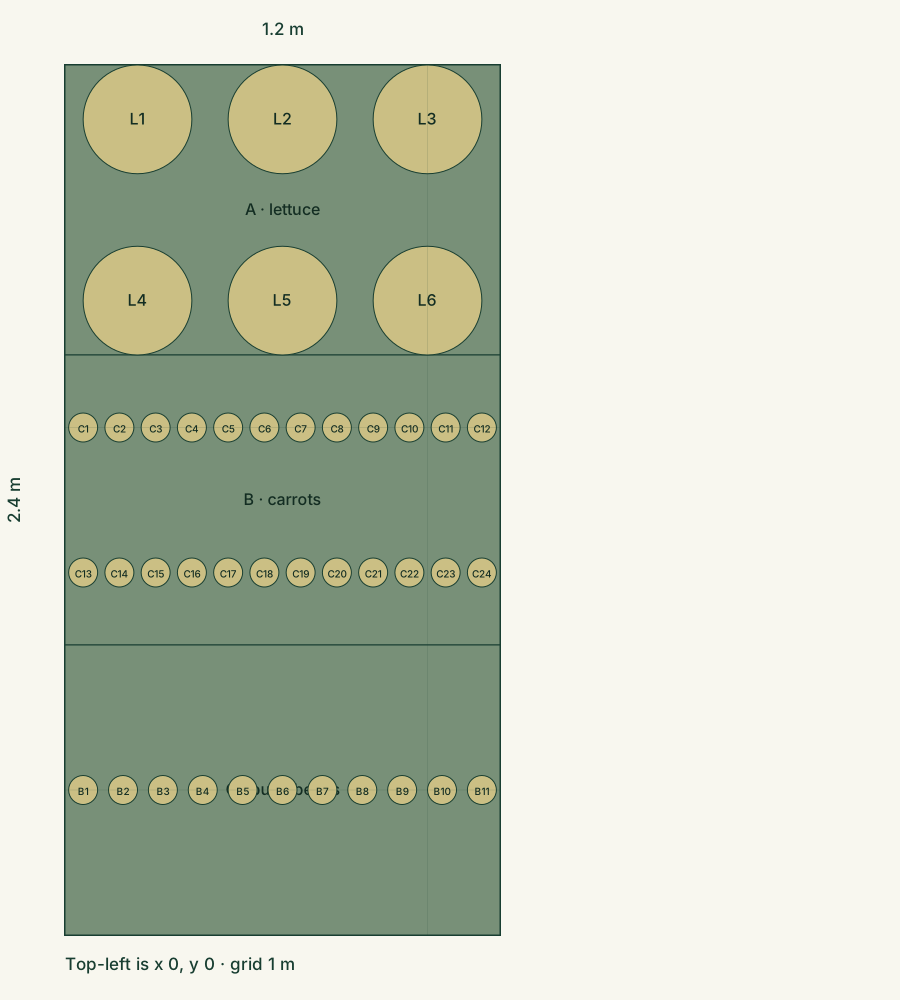
The internal growing area is 1.2 × 2.4 = 2.88 m². Each of the three 0.8 m-long blocks is 0.96 m². Labels L, C and B identify lettuce, carrot and bush-bean positions. The small crop circles mark root positions; they do not claim that mature bean canopies are only 8 cm wide.
| Block | Crop and quantity | Spacing used |
|---|---|---|
| A · y 0–0.8 m | 6 lettuces: 3 in each of 2 rows | 40 cm within rows; 50 cm between rows |
| B · y 0.8–1.6 m | 24 carrots: 12 in each of 2 rows after thinning | 10 cm within rows; 40 cm between rows |
| C · y 1.6–2.4 m | 11 bush beans in one row | 11 cm between positions, with the whole 80 cm block for the row |
The lettuce allocation is generous relative to UMN's full-size plant spacing and retains its minimum row separation. The carrot in-row spacing follows the wider end of UMN's thinning range; the row distance sits within Utah State's home-garden guidance. The single bush-bean row uses slightly more than UMN's 4-inch seed spacing. Confirm the chosen cultivar and adjust if its instructions require more room.
Place the bush-bean block so its taller growth does not unnecessarily shade the other crops, accounting for your hemisphere and actual sun. No north arrow is implied. This is a mixed-crop layout, not a claim that the crops protect one another from pests.
Open the editable food-bed plan and select “Use this example.” Its plant inventory should read 6 lettuce, 24 carrots and 11 bush beans. Later succession crops are not added to this simultaneous inventory.
Set out the positions without guessing
Use the top-left corner as x 0, y 0. Lettuce centres are x 0.2, 0.6 and 1.0 m, at y 0.15 and 0.65 m. Carrot centres run x 0.05 to 1.15 m in 0.10 m steps, at y 1.0 and 1.4 m. Bean centres run x 0.05 to 1.15 m in 0.11 m steps, at y 2.0 m.
Show all 41 coordinates
| Label | x | y |
|---|---|---|
| L1 | 0.2 | 0.15 |
| L2 | 0.6 | 0.15 |
| L3 | 1 | 0.15 |
| L4 | 0.2 | 0.65 |
| L5 | 0.6 | 0.65 |
| L6 | 1 | 0.65 |
| C1 | 0.05 | 1 |
| C2 | 0.15 | 1 |
| C3 | 0.25 | 1 |
| C4 | 0.35 | 1 |
| C5 | 0.45 | 1 |
| C6 | 0.55 | 1 |
| C7 | 0.65 | 1 |
| C8 | 0.75 | 1 |
| C9 | 0.85 | 1 |
| C10 | 0.95 | 1 |
| C11 | 1.05 | 1 |
| C12 | 1.15 | 1 |
| C13 | 0.05 | 1.4 |
| C14 | 0.15 | 1.4 |
| C15 | 0.25 | 1.4 |
| C16 | 0.35 | 1.4 |
| C17 | 0.45 | 1.4 |
| C18 | 0.55 | 1.4 |
| C19 | 0.65 | 1.4 |
| C20 | 0.75 | 1.4 |
| C21 | 0.85 | 1.4 |
| C22 | 0.95 | 1.4 |
| C23 | 1.05 | 1.4 |
| C24 | 1.15 | 1.4 |
| B1 | 0.05 | 2 |
| B2 | 0.16 | 2 |
| B3 | 0.27 | 2 |
| B4 | 0.38 | 2 |
| B5 | 0.49 | 2 |
| B6 | 0.6 | 2 |
| B7 | 0.71 | 2 |
| B8 | 0.82 | 2 |
| B9 | 0.93 | 2 |
| B10 | 1.04 | 2 |
| B11 | 1.15 | 2 |
The numbers are final growing positions, not a promise that every seed germinates or every plant yields. Buy six suitable lettuce transplants or start enough seed for that final selection. Carrots and beans are direct-sown here; seed-packet quantities, germination and any permitted reseeding determine the purchase, not a claim that exactly 35 seeds always suffice.
Turn local frost assumptions into working dates
The following dates are an illustrative 2027 season with last spring frost 15 May and first autumn frost 15 October: 153 days between those estimates. They are not weather predictions or universal planting dates. Use local guidance, soil warmth, forecast and seed instructions before acting.
| Crop | Starting assumption | Calculated dates |
|---|---|---|
| Leaf lettuce | 4 weeks indoors before 15 May transplant; example 40 days from transplant to first maturity | Start 17 April; transplant 15 May; first maturity 24 June. Adapt lettuce dates |
| Carrot | Direct sow 14 days before last frost, only with suitable soil; example 70 days from sowing | Sow 1 May; first maturity 10 July. Adapt carrot dates |
| Bush bean | Direct sow 14 days after last frost, only after soil warms; example 60 days from sowing | Sow 29 May; first maturity 28 July. Adapt bean dates |
Four weeks is UMN's approximate lettuce transplant lead time; the chosen maturity values are example cultivar assumptions that must be replaced by your seed information. Carrots are not started indoors in this plan. A hot lettuce season or cold bean soil can invalidate the dates even when the arithmetic is correct.
Plan succession by when a block becomes free
A first harvest is not the same as an empty bed. Lettuce may be picked leaf by leaf, carrots may be harvested gradually and beans may continue producing. Record the actual date each block is cleared before assigning its next crop.
For the example beans, 15 October minus 60 maturity days minus a 14-day margin gives 2 August as the latest sowing to reach first maturity with that margin. If the first bean crop is kept until 15 August, sowing another 60-day crop in the same block then misses that target. A second sowing would need another free block, a genuinely shorter suitable crop, an earlier end to the first crop, or abandonment of the second crop. The calendar cannot make the space or season longer.
For lettuce or another cool-season replacement, assess summer germination and autumn growth locally. Maryland Extension describes both sequential and overlapping sowings; overlap requires separate space until the earlier crop is removed. Save a second dated version of the drawing for succession rather than doubling the plant count in the first version.
Keep a family-and-location record for later crop rotation. A tiny garden may not provide a full rotation away from a problem, so use local pest and soil guidance rather than assuming that moving a crop 80 cm prevents disease.
Calculate fill and purchasing units separately
If the empty internal bed genuinely needs 30 cm of fill, the geometric volume is 1.2 × 2.4 × 0.30 = 0.864 m³, or 864 litres. That rounds up to 18 bags of 50 litres before any separate allowance. An in-ground bed does not automatically need this imported volume, and an existing partly filled bed needs its actual remaining depth measured.
Open the 864-litre calculation. Verify material suitability, settling, obstructions and supplier specifications before ordering. The 30 cm figure is a worked volume assumption, not a universal root-depth, structural or contamination-barrier specification.
In the budget, distinguish six transplants from one packet of carrot seed and one packet of bean seed. Add suitable bed materials if needed, fill, delivery, water provision, protection and your chosen allowance. Prices are local inputs; no savings or yield are guaranteed.
Keep a short, useful care routine
During germination, inspect the seed rows and root-zone moisture frequently; a crusted or dry surface can frustrate establishment. Thin carrots to the final positions and record gaps. After transplanting lettuce, check the individual root balls and protect the young plants as local conditions require.
As crops grow, watch moisture, crowding and signs of pests or disease. Identify a problem before choosing a treatment, and follow local edible-crop guidance. Pick at the appropriate stage and handle produce hygienically. The linked crop sources provide the detailed growing advice; this plan keeps the space and timing decisions together.
At season's end, record what was harvested, what failed, the work required and when each block became free. Keep the drawing JSON, dated crop checklists and readable brief. A smaller well-observed second season is more useful than expanding on an assumed harvest.
Keep the assumptions visible
Sources & checks
The layout and calculations are original illustrative examples. Horticultural and access guidance is informed by the sources below, checked on 3 October 2026. Local conditions still determine suitability.
- University of Minnesota: lettuce types, spacing and crop care
- University of Minnesota: carrots, direct sowing and thinning
- University of Minnesota: bush-bean spacing and warm-soil requirements
- Utah State Extension: carrot row spacing and local-frost approach
- University of Maryland: succession planting, updated 30 July 2026
- US EPA: lead-contaminated soil and gardening precautions
Prepared with AI assistance. No on-site assessment or professional approval is implied. Read our editorial approach.