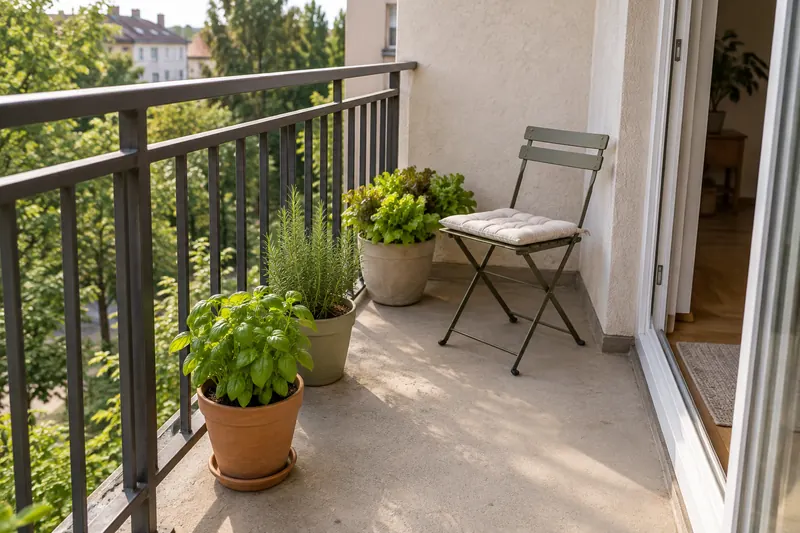
A balcony is a growing site and part of a building. Before choosing a lush photograph to copy, establish what the building permits, what it can carry and how water will reach and leave the containers. Unknown answers are reasons to keep the design provisional.
Complete the checks that change the whole plan
Ask the building owner or manager about gardening, attachments, runoff and access requirements. Obtain qualified confirmation of suitability for the proposed total load: containers, saturated growing medium, retained water, furniture, people and any other objects. A pot's empty weight is not enough information. This guide and the planner cannot calculate or certify balcony capacity.
The RHS balcony and roof guide identifies structural capacity, wind and water supply as starting checks. It does not make a generic arrangement safe for a particular building. Keep the confirmation with your shopping notes.
Record the door swing, the route back indoors, exposed edges and drainage outlets. For this renter example, no drilling means no drilled trellis, wall hooks or rail-mounted system. A supposedly freestanding tall screen still needs a wind and stability assessment; “removable” does not mean it cannot fall.
Use the smallest arrangement that meets the brief
This example allocates a possible 0.55 × 1.2 m container zone at the left, a 0.6 × 0.6 m folding-chair footprint toward the right and a clear 1.2 × 1 m door-route zone. Those footprints total 2.22 m² within a 4.5 m² balcony. The remaining 2.28 m² is unallocated movement space, not permission to add more weight.
Test the furniture and door opening at full size. The chair footprint does not include every movement needed to sit down or stand up. If the arrangement fails the personal access trial, reduce the contents. Keep objects back from edges and follow building-specific requirements.
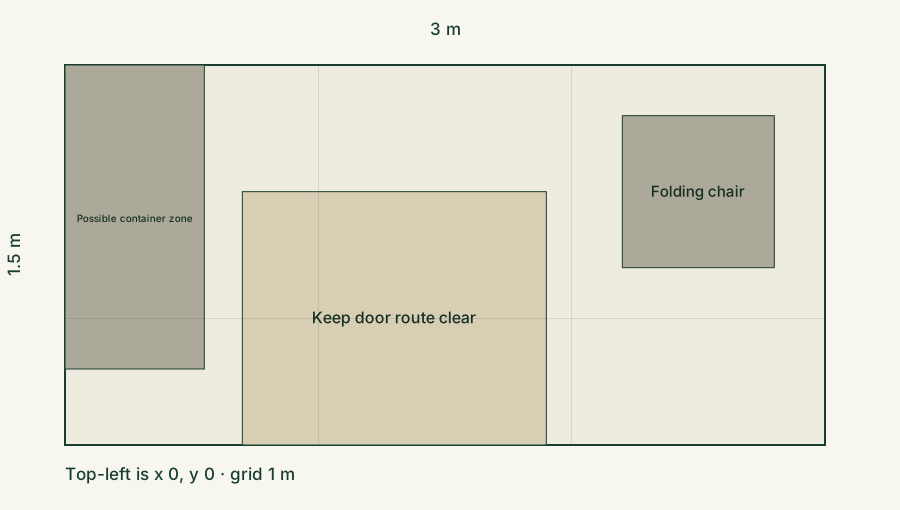
The editable concept records possible locations only. It deliberately does not prescribe a container count, saturated weight or fixed screen while those facts are unknown.
Compare three reversible approaches
One approved container group and one chair
Best when relaxation is the main aim and you can care for a small number of plants well. Group plants with compatible water needs. Reject the idea until total loading, stability and drainage have been confirmed.
A small edible trial
Best when the sunny location and your watering routine fit a specific crop. Begin with one manageable crop rather than a mixed miniature allotment. A compact plant label does not establish that its roots, support or container will suit the balcony.
A seasonal display that comes indoors or is renewed
Best when you want a changeable colour accent and accept replacement or overwintering work. It may be less permanent, but that is not automatically cheaper or lower effort. Avoid buying more plants than your absence plan can support.
Make a five-day absence plan and test it
Afternoon sun and exposed wind are reasons to test the actual containers before relying on a five-day absence. The RHS container-care guide calls for regular moisture checks, particularly in warm or windy weather; a fixed watering interval cannot describe every pot.
Choose among a reliable person checking the plants, an appropriately installed and tested irrigation arrangement, or a reservoir container approved as part of the load plan. Include stored water in the loading discussion. Never assume that a label saying “self-watering” guarantees five unattended days.
Run the proposed arrangement while you are home. Record the water level and root-zone moisture each day, including a representative warm or windy period. If it fails sooner than your trip length, change the arrangement, ask for visits or postpone planting. Moving suitable plants to a sheltered position may help, but the new position must still have safe access and adequate conditions.
Choose plants after the conditions are known
Separate hours of direct sun from a general “bright” impression. Then shortlist plants for exposure, container culture, mature spread and local winter conditions. A sheltered shade plant is not a good experiment in a hot wind tunnel. Conversely, a drought-adapted plant in the ground may still need frequent checking in a container.
Use the botanical name to check regional invasive restrictions and toxicity where people or animals can reach the plant. Do not eat a plant based on an AI image or a decorative common name. Food crops also need an appropriate growing medium and an identified source.
Keep only one or two experimental variables at first. If you change the plant, container, compost and watering system together, a failed trial tells you very little about the cause.
Take a useful brief to the next step
Record these decisions in the garden notebook: building confirmation still needed or obtained; permitted attachments; actual clear route; measured light; wind exposure; selected plant and container specifications; water supply; runoff plan; the five-day trial result; and who will check the space during exceptional weather.
Price the whole arrangement in the budget tool, including the container, appropriate medium, plant, support if permitted and watering provision. Keep the load and permission checks ahead of purchase. If the needed confirmations never arrive, retain the drawing as a concept and use the balcony for its already approved purposes.
Keep the assumptions visible
Sources & checks
The layout and calculations are original illustrative examples. Horticultural and access guidance is informed by the sources below, checked on 3 October 2026. Local conditions still determine suitability.
- RHS: balconies and roof gardens — structural, wind and water checks
- RHS: container maintenance — water, feeding and winter care
Prepared with AI assistance. No on-site assessment or professional approval is implied. Read our editorial approach.