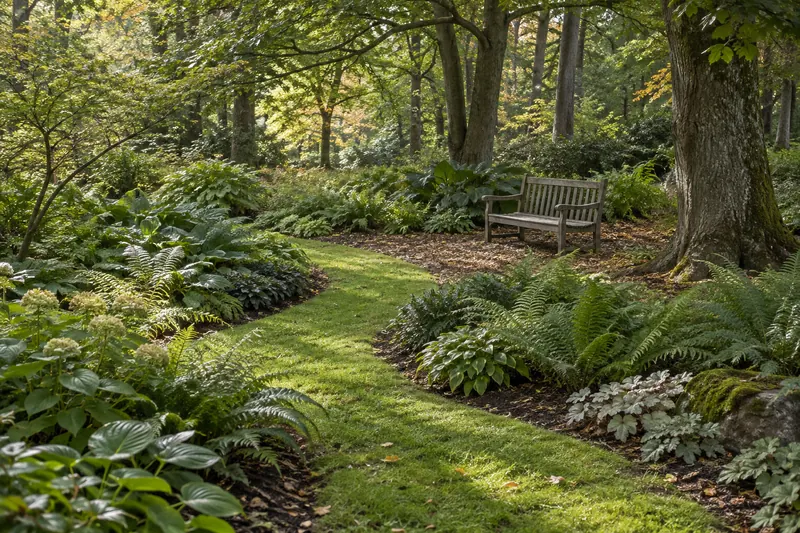
A woodland garden is a relationship between canopy, ground and seasonal light. The trees are the starting structure, not obstacles to excavate around in pursuit of a lush photograph.
Read the canopy through the seasons
Record where direct light reaches the ground before and after deciduous trees leaf out. Evergreen canopy, building shade and a leafless winter tree create different growing environments. Then check moisture: shade beneath a thirsty root system can be dry even in a generally wet region.
Choose a spring-led ground layer where seasonal light supports it, a foliage-led garden where shade persists, or a restrained path-and-seat intervention where root competition leaves little planting opportunity. Reject a moisture-loving palette if the ground repeatedly dries and you cannot provide appropriate establishment care.
Map the trees before drawing the beds
For a 7 × 5 m space, plot trunks, visible roots, existing ground levels and canopy spread before adding any new feature. The 35 m² outline is not 35 m² of freely excavatable soil. A qualified arborist may need to define protection and allowable work around important trees.
Place a provisional 2 × 2 m sitting area and a route to it only where existing conditions and professional advice permit. Try the route on the surface first. Do not cut roots, pile soil over them or specify paving construction from this sketch. Record protected and uncertain zones in the plan notes.
Use small planting groups with a clear fit
Where moist, draining partial shade is confirmed, the courtyard palette shows one fern-and-low-layer combination with reconciled quantities. It is a ground-level example, not permission to install those beds under an existing tree.
For drier compatible shade, inspect the profile for Polystichum acrostichoides and compare its needs with Bergenia crassifolia. A plant's tolerance of occasional dryness does not establish that it will thrive in severe root competition. Trial a few suitable positions without disturbing important roots before expanding.
Choose materials that keep the experience coherent
A quiet surface and a limited number of focal points allow trunks, shadows and foliage to dominate. Loose surfaces, exposed roots and irregular stepping routes may be difficult for some users. Test access with the actual gardener and obtain an appropriate tree-sensitive surface design where needed.
Retain useful existing leaf litter and habitat where compatible with plant health, access and local advice. Keep paths, drainage points and seating clear. A log used as habitat is different from a certified seat or play object; place it accordingly and do not collect material from protected habitats.
Let observation replace unnecessary intervention
During establishment, check individual new plants for water stress and competition. Later, watch for paths narrowing, aggressive spread and failing tree limbs. Tree-health concerns need qualified assessment, especially near occupied areas.
Record spring, summer and winter views. If summer foliage is attractive but spring is bare, investigate suitable early-season plants rather than filling gaps with a sun-loving summer annual. If repeated planting fails in a root-dense area, keep that ground as protected habitat and move the garden experience to a more workable edge.
Keep the assumptions visible
Sources & checks
The layout and calculations are original illustrative examples. Horticultural and access guidance is informed by the sources below, checked on 3 October 2026. Local conditions still determine suitability.
- RHS: shade planting combinations
- RHS: planning a border for its conditions
- NC State: Polystichum acrostichoides
Prepared with AI assistance. No on-site assessment or professional approval is implied. Read our editorial approach.