The useful layout is the one you can sow, inspect, thin and harvest without damaging the soil or crops. Crop spacing and route space should be visible before you order seed.
Match the layout to the job
Short blocks in a narrow bed work when you want small amounts of several crops and can reach the whole area. Our 1.2 × 2.4 m example has three explicit crop blocks. Dividing a bed into squares is a way to organize it; it does not override the selected cultivar's spacing.
Longer rows in separate beds make repeated inspection and picking easier to organize. They suit a larger commitment to a few crops, but can produce more at once than you want. Plan harvesting and use before increasing the sowing.
A potager gives perennial herbs, fruit, annual crops and flowers their own defined spaces. It can be decorative and productive, but its circulation and edges reduce the area available for crops. See the four-part example.
Two beds and a real service route
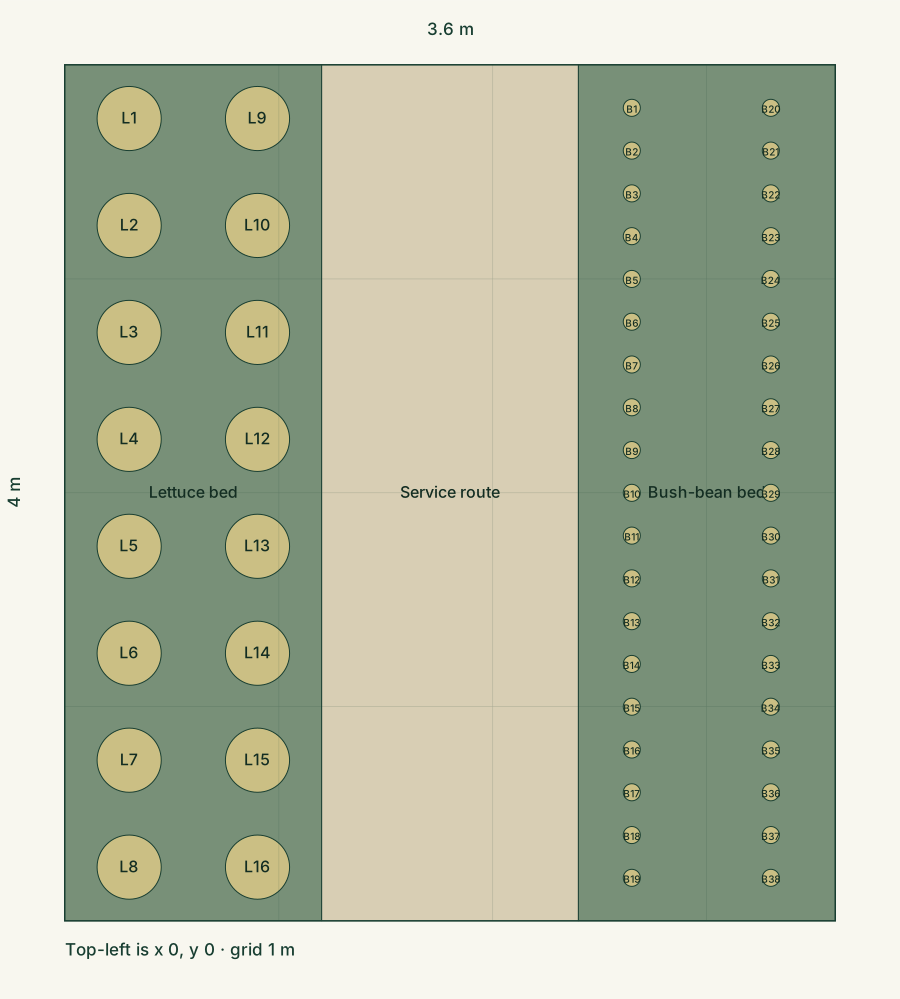
This original 3.6 × 4 m layout contains two 1.2 × 4 m beds and a 1.2 × 4 m central route. That is 9.6 m² of growing ground and 4.8 m² of route, adding to the 14.4 m² outline. External routes are not included. Test reach from the intended sides and alter widths before building.
The lettuce bed has two rows at x 0.3 and 0.9 m. Each has eight centres from y 0.25 to 3.75 m, every 0.5 m: 16 lettuce positions. The bean bed has rows at x 2.65 and 3.3 m; each has nineteen positions from y 0.2 to 3.8 m, every 0.2 m: 38 bush-bean positions. The bean rows are 65 cm apart, slightly more than two feet.
The drawing uses small bean root-position markers, not mature canopy sizes. Check actual cultivar instructions and orient the beds to avoid unnecessary shading. The two crop timings may overlap, but they are independently set by local conditions.
Make the quantities mean what you buy
Open the row-garden plan and select “Use this example.” Its inventory has 54 final growing positions. Sixteen lettuce transplants may be a purchasing unit; 38 bean positions are not a guarantee that buying exactly 38 seeds is sufficient. Packet size, germination and reseeding needs are separate.
For a purely geometric 5 cm layer over both beds, 9.6 × 0.05 = 0.48 m³, or 480 litres. That is ten 50-litre bags before allowance. This is not a prescription to cover active crops or every soil with that depth; select appropriate material and timing. The route does not belong in the planting-material calculation.
Use in-ground cultivation where the soil is suitable. Raised edges may clarify beds or improve working access, but do not make uncertain soil history safe by themselves. Investigate possible contamination before food growing.
Avoid creating an unwanted glut
Instead of transplanting all sixteen lettuces on one day, a gardener might assign eight positions to an earlier batch and eight to a later one. Label those positions and dates in the drawing; the total remains sixteen. Check that the second batch's local temperature and light still suit lettuce.
For beans, choose a batch size and picking commitment that fit your household. A later sowing in the same occupied row must wait for that row to become free. The succession guide shows how to distinguish first harvest from bed clearance and calculate the latest useful start.
Care for the route as well as the crop
Keep the central route usable when carrying water or harvested food. Weed little and often during establishment, inspect crop moisture and identify pests before deciding on treatment. A clear route can become narrow when foliage, hoses and temporary covers are added.
At the end of each crop, record the actual harvest period, clearance date and problems. Exchange crop families between suitable beds in later seasons where practical, but do not assume a short move prevents pests or disease. Reduce the next sowing if the work or harvest exceeded what you wanted.
Keep the assumptions visible
Sources & checks
The layout and calculations are original illustrative examples. Horticultural and access guidance is informed by the sources below, checked on 3 October 2026. Local conditions still determine suitability.
- University of Minnesota: lettuce spacing and care
- University of Minnesota: bush-bean spacing and warm-soil sowing
- Maryland Extension: succession and small-garden rotation limits
- US EPA: gardening where soil may contain lead
Prepared with AI assistance. No on-site assessment or professional approval is implied. Read our editorial approach.