A desert planting can have layers and changing flowers without being a collection of unrelated specimens. This original trial combines three distinct roles and gives them enough space to inspect. It is a candidate for locally verified warm-desert conditions, not a shopping list for every dry or sunny garden.
Choose between a warm-desert trial and a different dry garden
Choose this combination only after a local nursery, extension service or garden adviser confirms the exact plants for your soil, winter lows, heat and exposure. AMWUA reports a 25°F (about −3.9°C) hardiness threshold for brittlebush, the limiting cold reference in this group. A threshold is not a guarantee. A sheltered nursery plant, a newly planted root ball and an established landscape plant face different conditions.
For a temperate sunny garden with suitable winters and drainage, compare the lavender-and-sage border. For a persistently wet site, use the water diagnosis before choosing either. Do not reproduce a desert look by covering unsuitable soil with gravel.
Read the measured planting plan
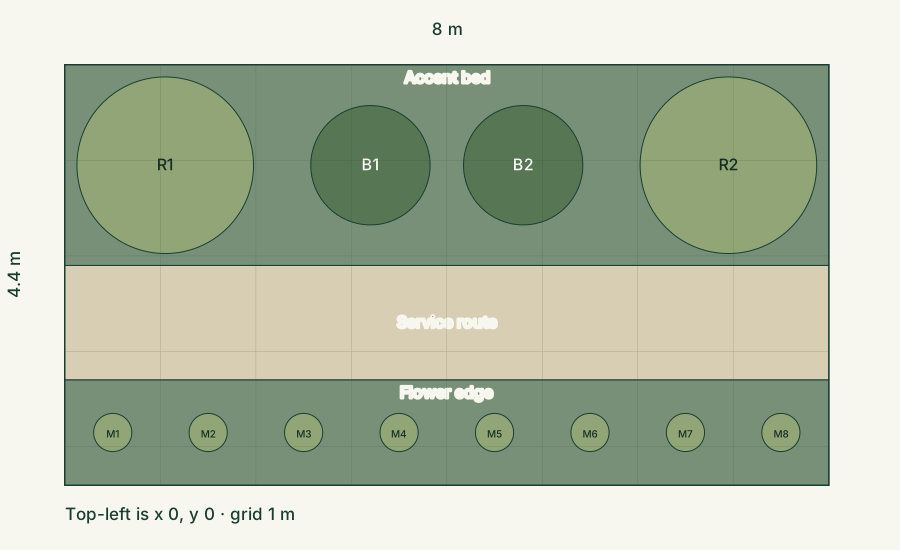
The outline is 8 × 4.4 m: 35.2 m². Planting beds occupy 25.6 m² and the internal route occupies 9.6 m². The top is the visual rear, not a compass bearing. Paths outside the outline are additional space. Test reach and maintenance access before copying it; widen access or divide deep beds where needed.
Circles reserve adult spread, not the size of a new nursery pot. Gaps are deliberate. Soil and neighbouring growth can change the eventual size, so check the named plants and keep the ability to edit the scheme. The diagram is an original concept, not an installed garden.
Open this layout in the planner, choose “Use this example,” then edit positions and dimensions. Its current plant inventory follows additions and deletions. Export the editable plan as well as the drawing.
Keep three planting roles distinct
The two red yuccas supply the larger arching forms. The two brittlebushes make a lower silver-leaved middle layer, while eight desert marigolds create a separate low flower edge. The middle route makes the contrast legible and allows inspection; external routes and any turning space remain additional.
Red yucca has a 1.85 m reserved diameter here, rounded above NC State’s larger reported spread. Arizona Extension describes a smaller typical clump, but offsets can enlarge the base. Do not shrink the reservation to make a crowded sketch work. Its flowers also rise above the leaves: check the view and nearby movement in elevation, not only from above.
These species have different native ranges. Red yucca’s adaptation to an Arizona garden does not make the whole palette locally native. If local habitat is the main objective, verify provenance and suitable regional replacements before calling the result a native planting.
Shopping list and exact positions
| Plant | Count | Diameter each |
|---|---|---|
| Hesperaloe parviflora | 2 | 1.85 m |
| Encelia farinosa | 2 | 1.25 m |
| Baileya multiradiata | 8 | 0.4 m |
Total: 12 individual planting positions. Open each profile for source-backed size, light, moisture, climate and safety checks. A botanical match alone does not establish local native status or suitability.
Show centre coordinates for setting out
Measure x from the left and y from the top. All coordinates are metres. Plant labels match the diagram.
| Label | Centre x | Centre y |
|---|---|---|
| R1 | 1.05 | 1.05 |
| R2 | 6.95 | 1.05 |
| B1 | 3.2 | 1.05 |
| B2 | 4.8 | 1.05 |
| M1 | 0.5 | 3.85 |
| M2 | 1.5 | 3.85 |
| M3 | 2.5 | 3.85 |
| M4 | 3.5 | 3.85 |
| M5 | 4.5 | 3.85 |
| M6 | 5.5 | 3.85 |
| M7 | 6.5 | 3.85 |
| M8 | 7.5 | 3.85 |
Set out empty pots or temporary markers first. Check views, access and the mature circles before planting. For a compatible material applied at an illustrative 5 cm depth, the full bed area would be 1280 litres before subtracting obstructions and crown clearances. This is geometry, not a prescribed mulch type or depth for every plant. Calculate your actual material and depth.
Understand what changes through the year
The persistent red-yucca forms are the visual anchors between flower displays. Brittlebush contributes a regional winter-to-spring flowering role. Desert marigold is a shorter-lived, self-renewing layer: Yavapai Extension describes annual or perennial behaviour and a March–November flowering window, while AMWUA uses a broader regional season. Expect variation, not continuous flowers everywhere.
Record the view in the coldest and hottest periods as well as at peak bloom. Leave gaps visible while plants establish. Eight original marigold positions do not promise eight permanent specimens; retain appropriate seedlings only where they preserve the spacing and access. If this renewal work is unwelcome, choose a separately verified longer-lived ground layer and redraw its adult dimensions.
Establish a water zone you can actually manage
Keep this trial separate from frequently watered food crops or containers. Inspect the original root balls and the surrounding ground during establishment, confirm that water reaches each plant, and check for runoff or persistent wetness. Arizona Extension’s red-yucca guidance distinguishes first-year irrigation from the later drought-adapted routine. Use local guidance for the other two species rather than assuming identical intervals.
Before an absence, identify who can inspect a failed emitter or a stressed new plant. The plan supplies no universal weekly volume, pipe specification or predicted percentage saving. A lower-water intention needs an actual water-use record before it becomes a measured result.
Keep access to crowns for selective care. Remove dead red-yucca leaves individually when appropriate instead of shearing the whole form. Investigate repeated decline before adding water or fertilizer. Update the drawing and inventory after a replacement.
Choose shade and sculptural alternatives at the correct scale
A blue palo verde is a possible regional canopy decision elsewhere in a sufficiently large, assessed site. AMWUA lists approximately 9.15 m mature width, greater than this entire 8 m trial. It is deliberately absent from the shopping list. Tree placement also needs roots, services, structures, litter, thorns and household sensitivities considered; a canopy circle alone is insufficient.
A cactus or agave would change the contact and access decisions. Do not replace a rounded plant with a spiny specimen on visual similarity alone. Verify the exact species, adult reach and maintenance approach, then relocate or enlarge its allocation. Where people must brush past, retain a different composition rather than relying on repeated cutting of spines.
Compare the wider desert design choices for seating, reflected heat and water-use zones. If wildfire rules affect the property, use the regional fire-aware briefing; drought tolerance does not establish fire performance.
Keep the assumptions visible
Sources & checks
The layout and calculations are original illustrative examples. Horticultural and access guidance is informed by the sources below, checked on 8 October 2026. Local conditions still determine suitability.
- RHS: planning a border from conditions and mature plant size
- NC State: red yucca dimensions and conditions: Hesperaloe parviflora — dimensions and conditions
- Arizona Municipal Water Users Association: regional plant record: Encelia farinosa — dimensions and conditions
- Arizona Municipal Water Users Association: regional plant record: Baileya multiradiata — dimensions and conditions
- University of Arizona: regional water-wise landscape design
- University of Arizona: red yucca establishment and maintenance
- University of Arizona: desert marigold lifecycle and flowering observations
These examples do not imply an on-site assessment or professional approval. Read our editorial approach.