A useful pollinator planting is more than a peak-season flower photograph. This example sequences flowering roles and keeps the remaining habitat questions visible: local range, nesting, shelter, pesticide exposure and what is missing at either end of the season.
Choose a local habitat aim
The three species have North American origins, but none receives a universal “native” badge here. Check your state, province or local ecological region and plant provenance. For a UK garden or another region, build a locally appropriate palette with equivalent seasonal roles instead of relabelling this one.
Choose this flower-led border where the site fits. Choose a meadow or naturalistic approach only if its establishment and cutting regime suits you. Keep existing useful habitat while adding resources; a new ornamental border is not automatically an improvement over what it replaces.
Read the measured planting plan
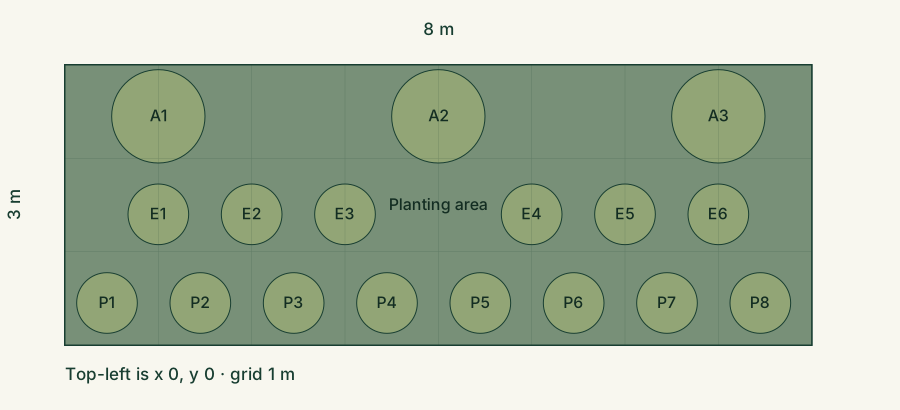
The outline is 8 × 3 m: 24 m². Planting beds occupy 24 m². The top is the visual rear, not a compass bearing. Paths outside the outline are additional space. Test reach and maintenance access before copying it; widen access or divide deep beds where needed.
Circles reserve adult spread, not the size of a new nursery pot. Gaps are deliberate. Soil and neighbouring growth can change the eventual size, so check the named plants and keep the ability to edit the scheme. The diagram is an original concept, not an installed garden.
Open this layout in the planner, choose “Use this example,” then edit positions and dimensions. Its current plant inventory follows additions and deletions. Export the editable plan as well as the drawing.
Read the sequence and its limits
Eight beardtongues provide the earlier flowering layer, six coneflowers the summer layer and three asters the later one. Exact dates vary with climate, cultivar and weather. The scheme does not cover every early-spring or winter resource need.
Asters can be tall enough to need support, so the rear positions include that care commitment. If you choose a shorter cultivar, confirm both its mature dimensions and its suitability for the intended habitat goal. Flower colour alone is not the relevant substitution test.
Shopping list and exact positions
| Plant | Count | Diameter each |
|---|---|---|
| Symphyotrichum novae-angliae | 3 | 1 m |
| Echinacea purpurea | 6 | 0.65 m |
| Penstemon digitalis | 8 | 0.65 m |
Total: 17 individual planting positions. Open each profile for source-backed size, light, moisture, climate and safety checks. A botanical match alone does not establish local native status or suitability.
Show centre coordinates for setting out
Measure x from the left and y from the top. All coordinates are metres. Plant labels match the diagram.
| Label | Centre x | Centre y |
|---|---|---|
| A1 | 1 | 0.55 |
| A2 | 4 | 0.55 |
| A3 | 7 | 0.55 |
| E1 | 1 | 1.6 |
| E2 | 2 | 1.6 |
| E3 | 3 | 1.6 |
| E4 | 5 | 1.6 |
| E5 | 6 | 1.6 |
| E6 | 7 | 1.6 |
| P1 | 0.45 | 2.55 |
| P2 | 1.45 | 2.55 |
| P3 | 2.45 | 2.55 |
| P4 | 3.45 | 2.55 |
| P5 | 4.45 | 2.55 |
| P6 | 5.45 | 2.55 |
| P7 | 6.45 | 2.55 |
| P8 | 7.45 | 2.55 |
Set out empty pots or temporary markers first. Check views, access and the mature circles before planting. For a compatible material applied at an illustrative 5 cm depth, the full bed area would be 1200 litres before subtracting obstructions and crown clearances. This is geometry, not a prescribed mulch type or depth for every plant. Calculate your actual material and depth.
Establish habitat without making unsupported claims
Inspect new planting, control unwanted competing plants and supply appropriate establishment water. Check plant sourcing and pesticide history where information is available. Follow regional guidance for nesting and shelter beyond the flower bed.
Record which flowers are open, observed visitors and the observation date. A single insect visit does not demonstrate a population increase. No promised biodiversity percentage or guaranteed pollinator outcome is attached to this design.
Maintain resources and access together
Retain useful stems or seed heads where appropriate and plan cutting in accordance with local habitat, access and fire requirements. Keep routes legible and inspect for spreading plants that suppress others. Do not clear the whole planting simply because one calendar date has arrived.
At the end of a growing cycle, identify the longest resource gap and decide whether a compatible local species elsewhere in the garden can fill it. Change one part deliberately, update the drawing and record the new quantities. The notebook can preserve the seasonal observations alongside the design choices.
Keep the assumptions visible
Sources & checks
The layout and calculations are original illustrative examples. Horticultural and access guidance is informed by the sources below, checked on 3 October 2026. Local conditions still determine suitability.
- RHS: planning a border from conditions and mature plant size
- NC State: Symphyotrichum novae-angliae — dimensions and conditions
- NC State: Echinacea purpurea — dimensions and conditions
- NC State: Penstemon digitalis — dimensions and conditions
- Xerces Society: pollinator conservation in yards and gardens
Prepared with AI assistance. No on-site assessment or professional approval is implied. Read our editorial approach.