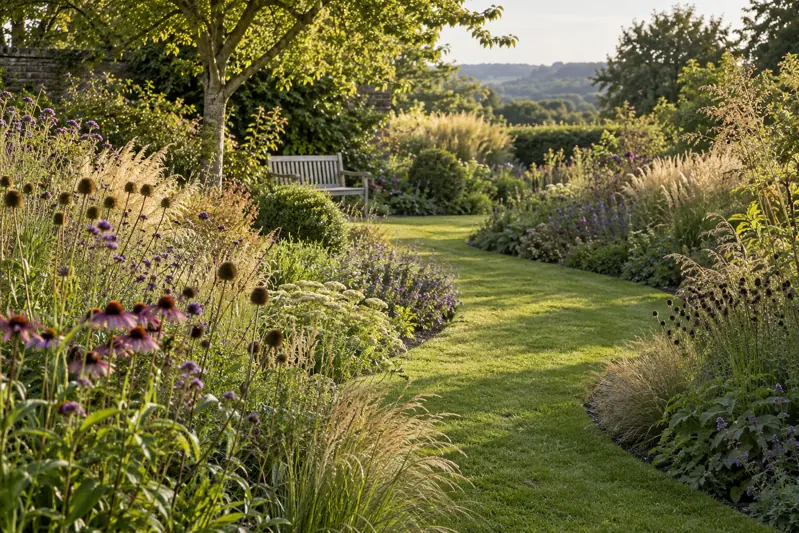
A loose, flowing garden can be carefully composed. The main decision is whether you want a designed perennial border, an established meadow community or a small experiment in longer grass. They have different establishment methods and different jobs to do.
Do not confuse the three starting points
A naturalistic border arranges selected plants in repeated groups or a matrix, with each plant deliberately placed. A meadow is managed as a plant community, usually with a distinct establishment and cutting regime. A longer-grass patch begins by observing what is already present. Choose the border when you need a legible composition quickly; choose a meadow only when you can prepare and manage the site appropriately.
Simply stopping mowing does not guarantee diverse flowers. Nor does sowing a packet into vigorous existing turf guarantee establishment. Assess the existing vegetation, soil and local species options before choosing the method. An annual flower display is another legitimate choice, but it is not the same thing as a permanent native meadow.
Create a manageable edge and a trial area
In an 8 × 6 m garden, keep a 1.2 m perimeter maintenance route. The internal rectangle is 5.6 × 3.6 m, or 20.16 m²; the route ring occupies 27.84 m². That unusually large route share is a useful warning: a ring may consume too much of a small site. A single edge route could leave more habitat.
Instead, trial a 3 × 3 m patch in a part of the garden you can inspect from two sides. Mark its edge clearly so changes look intentional and invasive weeds can be reached. Keep essential access, play and utility areas separate. Enter the actual patch in the planner before deciding how much to expand.
Build a local palette around roles
Choose structural grasses, flowering plants in different seasonal windows and a low layer that suits the same conditions. Panicum virgatum and Echinacea purpurea are possible components in suitable parts of their North American ranges; neither should be labelled native everywhere. Verify local range, soil, climate and any regional restrictions.
For a UK native meadow, begin with regional habitat and seed provenance advice instead of translating that North American pair directly. For an ornamental naturalistic border elsewhere, state that the aim is a composed appearance and evaluate wildlife value separately. Xerces' habitat guidance is useful for distinguishing food, nesting and shelter needs.
Design the winter and the work
Ask whether standing stems, seed heads, flattened patches and a period after cutting are acceptable from your main window. A seasonally changing garden will not look like its peak-summer photograph throughout the year. Keep a clear edge or repeated structural element to make that change readable.
Before planting, decide who cuts, how material is removed where appropriate, how unwanted plants are identified and how establishment water is supplied. Follow regional habitat advice for timing and refuges rather than clearing everything on one universal date. In fire-prone locations, obtain local defensible-space guidance before leaving dry vegetation near buildings.
Evaluate the trial by more than flowers
After a full growing cycle, record bare ground, unwanted species, lodging, weed-control time and the seasonal resources actually present. Photographs and dated observations are more useful than assuming an attractive packet label delivered a biodiversity gain.
If the patch needs more intervention than you can supply, reduce its size or choose a planted border with clearer individual positions. If it works, extend in stages while preserving existing useful habitat. Keep the work and purchased seed or plants in the budget and the observation log in your notebook.
Keep the assumptions visible
Sources & checks
The layout and calculations are original illustrative examples. Horticultural and access guidance is informed by the sources below, checked on 3 October 2026. Local conditions still determine suitability.
- Xerces Society: pollinator habitat in yards and gardens
- NC State: Panicum virgatum
- RHS: planning a border for its conditions
Prepared with AI assistance. No on-site assessment or professional approval is implied. Read our editorial approach.