Clay is not automatically bad soil. This plan uses its moisture-retaining potential where drainage remains suitable, while giving a broad shrub the space that a nursery pot can conceal.
Diagnose the ground before improving it
Record when the soil is wet, how long surface water remains and whether compaction or runoff appears to be contributing. Do not assume every clay site needs a drain or a raised bed. Drainage alterations require site-specific assessment, especially near buildings or neighbouring land.
Use this plan for a moist, draining clay loam. For a permanently saturated site, select a different habitat and obtain advice on the water problem. For dry, cracked ground with little available water, investigate a dry-site palette instead of keeping moisture-demanding plants alive by assumption.
Read the measured planting plan
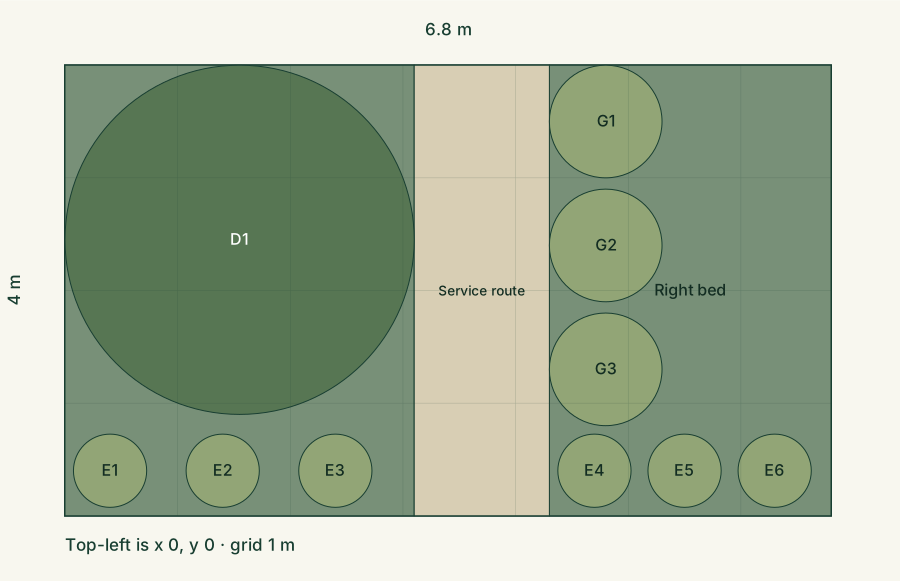
The outline is 6.8 × 4 m: 27.2 m². Planting beds occupy 22.4 m² and the internal route occupies 4.8 m². The top is the visual rear, not a compass bearing. Paths outside the outline are additional space. Test reach and maintenance access before copying it; widen access or divide deep beds where needed.
Circles reserve adult spread, not the size of a new nursery pot. Gaps are deliberate. Soil and neighbouring growth can change the eventual size, so check the named plants and keep the ability to edit the scheme. The diagram is an original concept, not an installed garden.
Open this layout in the planner, choose “Use this example,” then edit positions and dimensions. Its current plant inventory follows additions and deletions. Export the editable plan as well as the drawing.
Let one shrub have its real dimensions
The red-twig dogwood has a 3.1 m reserved diameter, reflecting the larger source spread. Three switchgrasses and six coneflowers occupy the other positions. A 1.2 m internal service route keeps the planting from becoming one inaccessible mass; test that width for the actual gardener and tasks.
The dogwood brings winter stems, the perennials a growing-season display and the grasses later structure. Pruning the dogwood for young colourful stems changes its flowering and mature appearance. Decide which outcome matters before treating it as a maintenance-free shrub.
Shopping list and exact positions
| Plant | Count | Diameter each |
|---|---|---|
| Cornus sericea | 1 | 3.1 m |
| Panicum virgatum | 3 | 1 m |
| Echinacea purpurea | 6 | 0.65 m |
Total: 10 individual planting positions. Open each profile for source-backed size, light, moisture, climate and safety checks. A botanical match alone does not establish local native status or suitability.
Show centre coordinates for setting out
Measure x from the left and y from the top. All coordinates are metres. Plant labels match the diagram.
| Label | Centre x | Centre y |
|---|---|---|
| D1 | 1.55 | 1.55 |
| G1 | 4.8 | 0.5 |
| G2 | 4.8 | 1.6 |
| G3 | 4.8 | 2.7 |
| E1 | 0.4 | 3.6 |
| E2 | 1.4 | 3.6 |
| E3 | 2.4 | 3.6 |
| E4 | 4.7 | 3.6 |
| E5 | 5.5 | 3.6 |
| E6 | 6.3 | 3.6 |
Set out empty pots or temporary markers first. Check views, access and the mature circles before planting. For a compatible material applied at an illustrative 5 cm depth, the full bed area would be 1120 litres before subtracting obstructions and crown clearances. This is geometry, not a prescribed mulch type or depth for every plant. Calculate your actual material and depth.
Work with the soil at a suitable time
Avoid turning a planting operation into repeated trampling of wet ground. Plan delivery, access and spoil handling before work begins, using appropriate local soil guidance. Investigate unsuitable structure rather than adding a universal mix of sand or fertilizer by guesswork.
After planting, inspect the root zones and the service route separately. Watch for water collecting at an edge or one bed remaining saturated. Keep a record of actual conditions so the response can be specific.
Choose size and pruning deliberately
If the full dogwood is too large, select a verified smaller cultivar and redraw its allocation. Do not buy the species and rely on indefinite severe pruning to make a small bed seem adequate. Keep access for renewal work and disposal of prunings.
As the perennial layer grows, review light and crowding near the shrub. Move an incompatible neighbour rather than feeding it harder. For a purely herbaceous alternative, the sunny perennial border avoids the large woody element, provided its own soil and light requirements fit.
Keep the assumptions visible
Sources & checks
The layout and calculations are original illustrative examples. Horticultural and access guidance is informed by the sources below, checked on 3 October 2026. Local conditions still determine suitability.
- RHS: planning a border from conditions and mature plant size
- NC State: Cornus sericea — dimensions and conditions
- NC State: Panicum virgatum — dimensions and conditions
- NC State: Echinacea purpurea — dimensions and conditions
Prepared with AI assistance. No on-site assessment or professional approval is implied. Read our editorial approach.