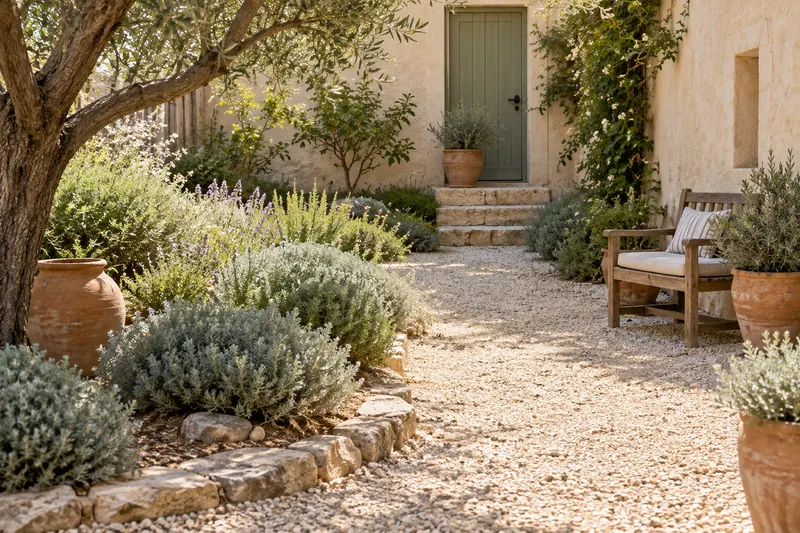
A Mediterranean-inspired garden can be relaxed and generous: a sheltered place to eat, aromatic planting, a limited material palette and enough shade to make hot hours usable. Its success depends on seasonal water and drainage, not terracotta alone.
Choose a climate strategy
In a suitable mild, dry-summer climate, permanent sun-loving planting may be the main structure. In a colder or wetter climate, use locally hardy plants with related forms and keep tender specimens limited to containers with a feasible winter location. Where summers are humid, choose plants that tolerate that condition rather than treating “Mediterranean” as a universal resilience label.
Reject a container olive or other tender focal plant if you cannot meet its actual winter, light and moving requirements. Choose an appropriate local woody structure instead. The desired relationship between a shaded seat, open ground and restrained planting can survive that substitution.
Plan comfort before the ornamental details
For an illustrative 5 × 6 m sunny plot, reserve a 3 × 3 m living zone near the house: 9 m². A 1.2 × 3 m route beside it uses 3.6 m². The remaining 17.4 m² must still accommodate planting, utility access and any approved shade structure. Draw each explicitly rather than assuming all the remainder is a border.
Observe the proposed seat during the hottest time you intend to use it. If it is uncomfortable, moving the seat may be simpler than adding a structure. Any pergola, fixed shade sail or attachment needs appropriate local assessment; this example supplies no fixing or foundation specification.
Separate dry planting from thirsty planting
Lavandula angustifolia offers aromatic foliage and summer flowers in suitable draining conditions. The profile includes climate and pet-toxicity cautions. Do not put it in the same wet pocket as a moisture-demanding display and try to solve the conflict with one watering regime.
Use a sunny dry border for compatible permanent plants, and place a small seasonal or food container where its separate watering can be checked. If the ground is winter-wet, investigate the cause and redesign the planting rather than assuming a top layer of gravel changes the underlying drainage.
Use an exact planting trial
Mark a 3 × 1 m test strip before converting the entire garden. Three lavender positions with 1 m allocated diameters fit at centres 0.5, 1.5 and 2.5 m along the length, all 0.5 m from the edge. Those generous envelopes use the profile’s mature spread allowance; they are not a nursery-pot spacing.
Keep this as a three-plant trial, with no hidden filler plants competing in the same circles. If a named cultivar is substantially smaller or larger, redraw before ordering. Photograph the strip through its wettest and driest seasons and compare survival, shape and care effort before expanding.
Keep establishment in the water budget
Drought adaptation does not mean a newly planted root ball can be left unchecked. Follow the plant and local guidance, checking soil and weather rather than watering by an unchanging calendar. Track the first season separately from the mature garden’s needs.
Include winter protection, container transport, replacement risk and approved shading in the cost plan. If those recurring commitments outweigh the appeal, keep the seat and colour palette but choose a simpler local planting scheme. The look should fit your life as well as your latitude.
Keep the assumptions visible
Sources & checks
The layout and calculations are original illustrative examples. Horticultural and access guidance is informed by the sources below, checked on 3 October 2026. Local conditions still determine suitability.
- RHS: garden design styles (definitions and historical context)
- RHS: drought-resistant gardening and establishment
- NC State: Lavandula angustifolia
Prepared with AI assistance. No on-site assessment or professional approval is implied. Read our editorial approach.